
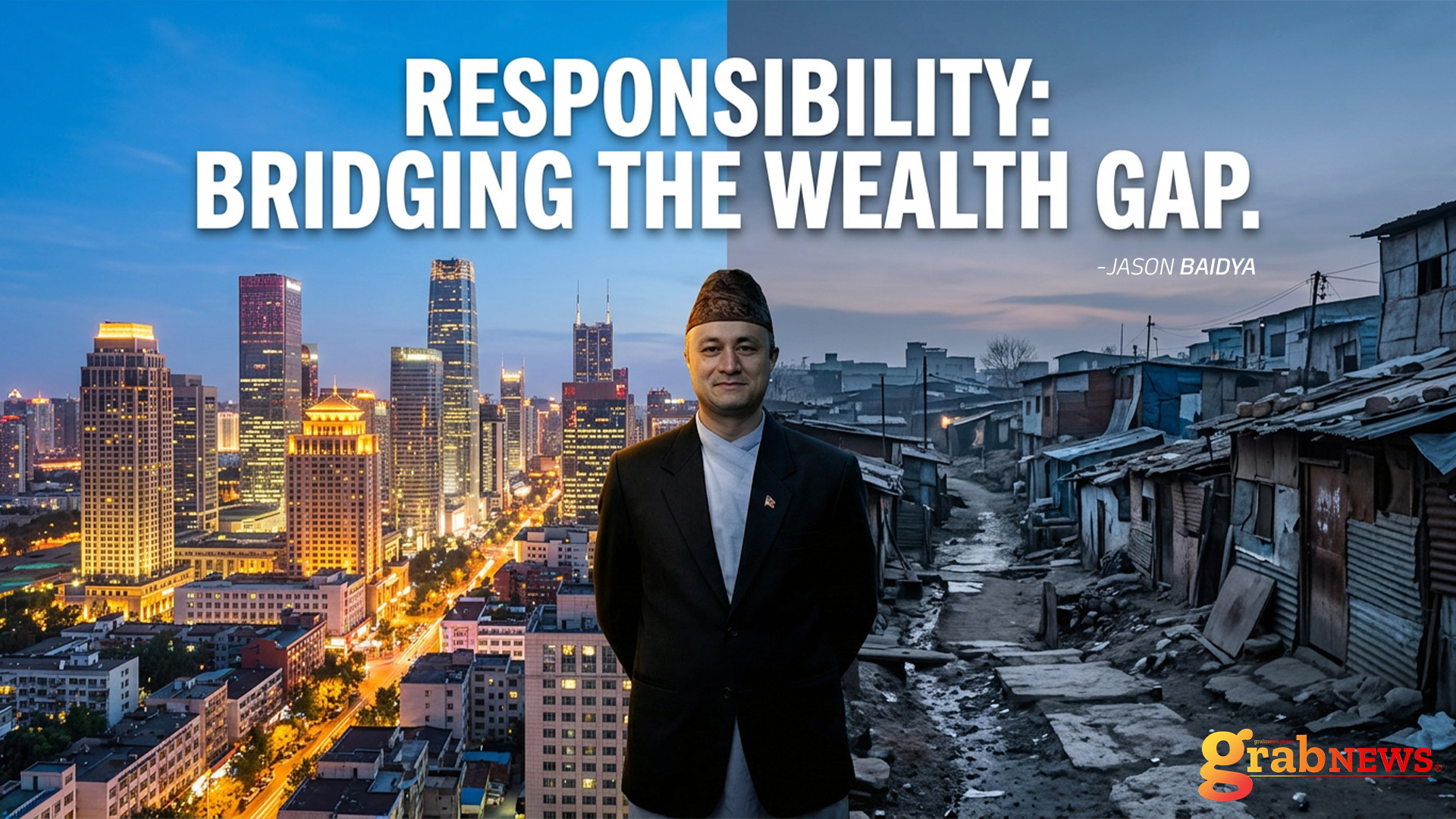
In every age, human beings have sought to understand the world through ideas. We build ideologies to make sense of fairness, freedom, and justice. Some find truth in the logic of markets, others in the ethics of equality. To choose an ideology is, in many ways, to answer a deeply personal question: What kind of world do I believe in? And in a free society, that question belongs to the individual.
But a state is not an individual. A state does not dream, believe, or choose in the same way a person does. It carries no personal conviction, no ideological identity of its own. Instead, it carries a burden a responsibility that is both practical and moral: to hold together the lives of millions who do not think alike, live alike, or aspire alike. Where individuals can afford conviction, the state must practice balance.
This becomes especially clear when we consider the difference between economic growth and economic development. Growth is visible, measurable, almost tangible. It is the language of numbers rising outputs, expanding industries, increasing wealth. It gives the impression of movement, of forward motion. But development asks a quieter, deeper question: Forward for whom? It shifts the focus from the scale of the economy to the condition of the human being. Are people merely participating in an economy, or are they flourishing within it? Are they healthier, more educated, more secure? Do they live with dignity, or merely survive within systems too large to notice them?
Growth counts. Development reflects. A state that pursues growth alone risks mistaking motion for meaning. It may build towering structures of wealth, yet leave shadows beneath them spaces where inequality deepens and opportunity fades. In such a system, progress becomes uneven, and the promise of prosperity becomes selective. This is the limitation of ideology when applied without reflection. A rigid commitment to any single doctrine whether rooted in markets or in state control reduces the complexity of human society into a single framework. But societies are not simple. They are living systems, shaped by contradictions, inequalities, and aspirations that cannot be resolved by one idea alone. The responsibility of the state, therefore, is not to be ideologically pure, but to be ethically grounded. It must borrow where necessary, adapt where possible, and intervene where required. It must recognize that markets can generate wealth, but not necessarily justice; that equality can be pursued, but not at the cost of vitality and innovation. The role of governance lies in navigating these tensions not eliminating them, but balancing them. In this sense, the state becomes less of an ideological actor and more of a moral institution. Its purpose is not to validate a theory, but to uphold a principle: that every citizen matters. And this principle finds its clearest expression in the question of inequality.
A society divided sharply between the “haves” and the “have-nots” is not merely unequal it is fractured. It reflects not just an economic gap, but a moral distance. When opportunity is inherited rather than created, when dignity is unevenly distributed, the very idea of collective progress begins to erode. This is why social upliftment is not optional; it is essential. It is the quiet work of closing distances between privilege and deprivation, between access and exclusion, between potential and reality. It ensures that education becomes a doorway rather than a barrier, that healthcare becomes a right rather than a luxury, and that opportunity is not confined to circumstance. A responsible state understands that development is not achieved when a few rise above the rest, but when the distance between them begins to narrow.
Because in the end, the measure of a nation is not found in its highest point, but in the space between its highest and its lowest. To govern, then, is not simply to manage resources or enforce laws. It is to shape the conditions under which human lives unfold. It is to decide, consciously or unconsciously, who gets to move forward and who is left waiting. That is why the state must rise above ideology. Individuals will continue to believe, to argue, to align themselves with different visions of the world. That diversity is not a weakness; it is a strength. But the state must remain anchored in something deeper than belief it must remain anchored in responsibility. Not to an idea, but to its people. Because true progress is not defined by how far a nation advances, but by how many it carries forward with it.
- Jason Baidya