
Kathmandu, March 28, 2026
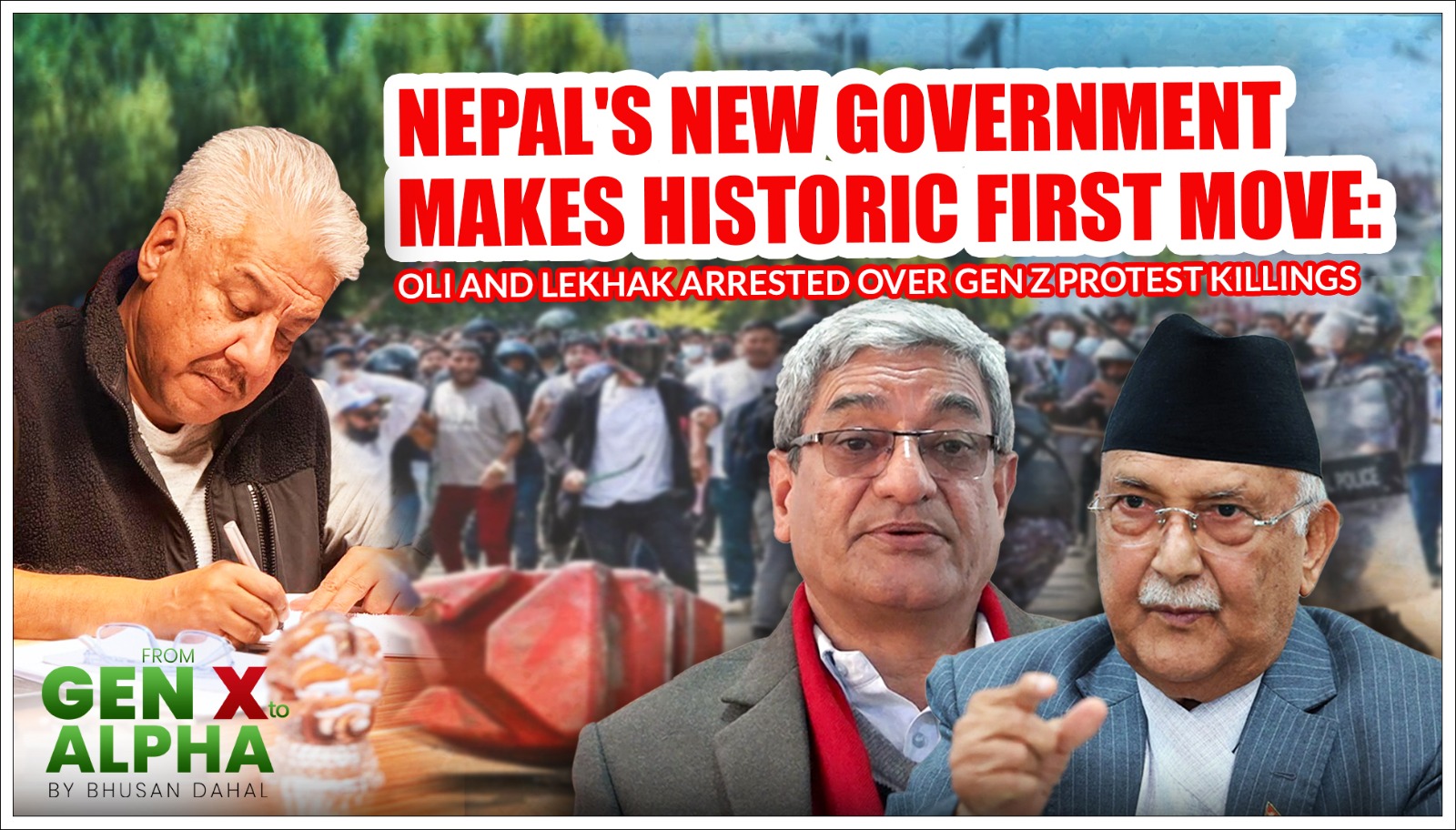
In one of the most dramatic opening acts of any government in Nepal’s modern political history, the newly sworn-in administration of Prime Minister Balendra Shah moved within hours of taking office to arrest former Prime Minister KP Sharma Oli and former Home Minister Ramesh Lekhak — acting on the recommendations of a controversial inquiry commission into last year’s deadly Gen Z uprising.
A New Government, A Swift Reckoning
Shah, the 35-year-old mayor-turned-politician, and his Rastriya Swatantra Party (RSP) swept the March 5 elections on a platform of youth-driven change. The RSP did what many thought impossible, winning 182 of 275 seats — becoming the first party since 1999 to secure a parliamentary majority in Nepal.
Police arrested former Prime Minister KP Sharma Oli from his residence in Gundu, Bhaktapur on Saturday morning. Former Home Minister Ramesh Lekhak was detained even earlier, around 5am, from his residence in Suryabinayak, Bhaktapur. The arrests followed a formal complaint filed by the Home Ministry, which triggered an investigation and led to the issuance of arrest warrants. Police officials stated the action was carried out to implement recommendations made by a commission led by former Special Court judge Gauri Bahadur Karki.
The Protest That Changed Nepal
On September 8, police opened fire on crowds, killing 17 in Kathmandu alone and 2 more in Itahari — 19 dead across the country, with over 300 injured. The protests were driven by public fury over government corruption and the ostentatious display of wealth by officials and erupted alongside a nationwide ban on 26 social media platforms. On September 9, with parliament and the Supreme Court set ablaze, Oli resigned, the army briefly assumed control, and an interim government was subsequently formed with input from protest leaders.
What the Commission Found
The government formed the Karki Commission on September 21 to investigate the state crackdown. During its inquiry, the commission recorded statements from over 150 individuals, including government officials and eyewitnesses.
The commission’s 907-page report concludes that Oli, Lekhak, and then Inspector General of Police Chandra Kuber Khapung are liable under the negligence and recklessness provisions of the National Penal Code for failing to stop the use of force by security personnel. The commission recommended investigation under Sections 181 and 182 of the National Penal Code, the central basis being that firing continued for more than four hours with no attempt made to stop it. Offences under these sections carry sentences of three to ten years imprisonment along with fines.
The Army Chief told the commission that at the height of the unrest he had presented Oli with two options — a political resolution including resignation, or the constitutional deployment of the army — and that intelligence agencies had warned of a possible escalation at a Central Security Committee meeting on September 7, yet no formal National Security Council meeting was convened until September 9.
September 9 and the Commission’s Silence: The Question of One-Sided Justice
Perhaps the most pointed criticism levelled at the Karki Commission’s report is this: by focusing almost entirely on the state’s use of force on September 8, it has conspicuously ignored the widespread violence, anarchy, and resulting deaths of September 9 — a day whose death toll and destruction in many respects surpassed even the carnage of the day before.
On September 9, homes of politicians were set ablaze across the country. Former Prime Minister Sher Bahadur Deuba and his wife, Foreign Minister Arzu Rana Deuba, were seriously injured when their residence was torched. Deputy Prime Minister Prakash Man Singh’s home and vehicles were set on fire. Former President Bidhya Devi Bhandari’s residence was burned. Former Prime Minister Jhalnath Khanal’s home was set alight, seriously injuring his wife Ravi Laxmi Chitrakar. Former Prime Minister Prachanda’s Chitwan residence and his daughter Ganga Dahal’s home in Lalitpur were also burned — a body was found at the latter the following day.
Parliament, the presidential palace, the Supreme Court, federal offices, schools, hotels, and private properties were set ablaze. Prisons across the country were stormed and thousands of inmates freed. The commission’s own report acknowledges total property damage of approximately 8.5 billion rupees.
Most gravely, police stations were attacked, weapons were looted, and officers were forced to flee. Three police personnel were killed in mob attacks — confirmed by police officials and the physicians who conducted post-mortem examinations. The commission’s own report acknowledges that of the 76 deaths it documents, three were police personnel killed in mob attacks, and the rest died during looting.
Yet despite the sheer scale of these events, the Karki Commission made no substantive recommendation toward identifying or prosecuting those responsible for the killings of police personnel, the mob lynchings, or the arson and looting of September 9. The commission’s gaze remained trained almost exclusively on the state’s conduct of September 8.
This silence becomes more striking when one examines the commission’s own composition. The Karki Commission was chaired by former Special Court judge Gauri Bahadur Karki and included former Additional Inspector General (AIG) Biggyanraj Sharma as a member. In other words, a former senior police officer sat on the very commission that chose not to pursue accountability for the mob murder of his fellow officers. Critics have described this as a profound irony: the person best positioned to understand and advocate for the institutional realities facing police personnel stayed silent on the deaths of three of their own. Amnesty International drew attention to this gap, stating that while its briefing focuses on September 8, it strongly condemns the violence perpetrated by crowds against people and property on September 9 and the days that followed — including deaths and serious injuries — and that authorities must identify those potentially responsible for such violence and pursue appropriate legal action.
Human Rights Watch similarly stated that any investigative commission must examine events on both September 8 and 9 — covering the role of security forces, credible allegations of infiltration, and criminal acts that contributed to violence.
A Commission Under a Cloud
The arrests are not without significant legal controversy. The Karki Commission’s legitimacy has been challenged from its inception.
Even before his appointment as chair, Karki had written on social media about the events of September 8–9, stating that KP Oli, Sher Bahadur Deuba, Pushpa Kamal Dahal, and other former ministers should not be allowed to leave the country, and publicly expressing the view that specific leaders should be detained and investigated.
A legal challenge was brought before the Supreme Court. A full bench comprising Justices Manoj Kumar Sharma, Nahkul Subedi, and Shrikanta Paudel delivered a verdict acknowledging serious concerns, noting that Karki had already publicly expressed his view — that the then Prime Minister, Deputy Prime Minister, and heads of security agencies should be prosecuted — before the commission was even formed.
The court held that while Karki’s public expressions appear to raise questions about impartiality, there is no indication he lacks the legal qualifications for appointment. The judgment states that accepting responsibility to investigate matters on which one has already expressed opinions is a question of personal ethics and moral judgment. Critically, the court also issued a directive order to the government to ensure that future appointments to inquiry commissions on matters of public importance are made in a way that does not invite questions over impartiality.
Advocate Luintel noted that the Supreme Court did not question Karki’s qualifications but seriously questioned his impartiality and neutrality, and that Karki should have resigned on ethical grounds but did not.
The Nepal Bar Association has also raised concerns, arguing that the commission’s report prima facie exceeds the scope of its mandate and disregards the principle of separation of powers.
A Nation Watching
These arrests mark an unprecedented moment in Nepali political history, with a former prime minister facing criminal detention over the deaths of protesters during his watch. But when the same commission that drives these prosecutions ignores the victims of September 9’s violence — both the civilians caught in the mayhem and the police personnel killed by mobs — and when the Supreme Court itself has questioned that commission’s impartiality, the proceedings will struggle to be accepted as complete and even-handed justice.
Senior advocate Bipin Adhikari has noted that while anyone can be investigated for a criminal offence, a person is considered guilty only once the investigation establishes the charges, and that political and moral responsibility are distinct from criminal liability.
For Nepal’s Gen Z — the generation that brought down Oli’s government at enormous cost — the arrests represent a long-demanded reckoning. But any commission truly committed to the whole truth cannot afford to forget the victims of September 9, whether they were young protesters cut down by police bullets or officers beaten to death by mobs. Whether the courts ultimately agree is a chapter still to be written.
Note: This article is based on verified reporting as of March 28, 2026. Legal proceedings are ongoing and no verdict has been reached.
I think the author of this article has opened a Pandora’s box.He is I think trying to convey at large the implausible investigations conducted by the Commission.Although the events of 8 and 9 were profound and volatile in its nature,the Commission’s findings are certainly not helpful for future references nor are they of any practical value for the in coming Government.