
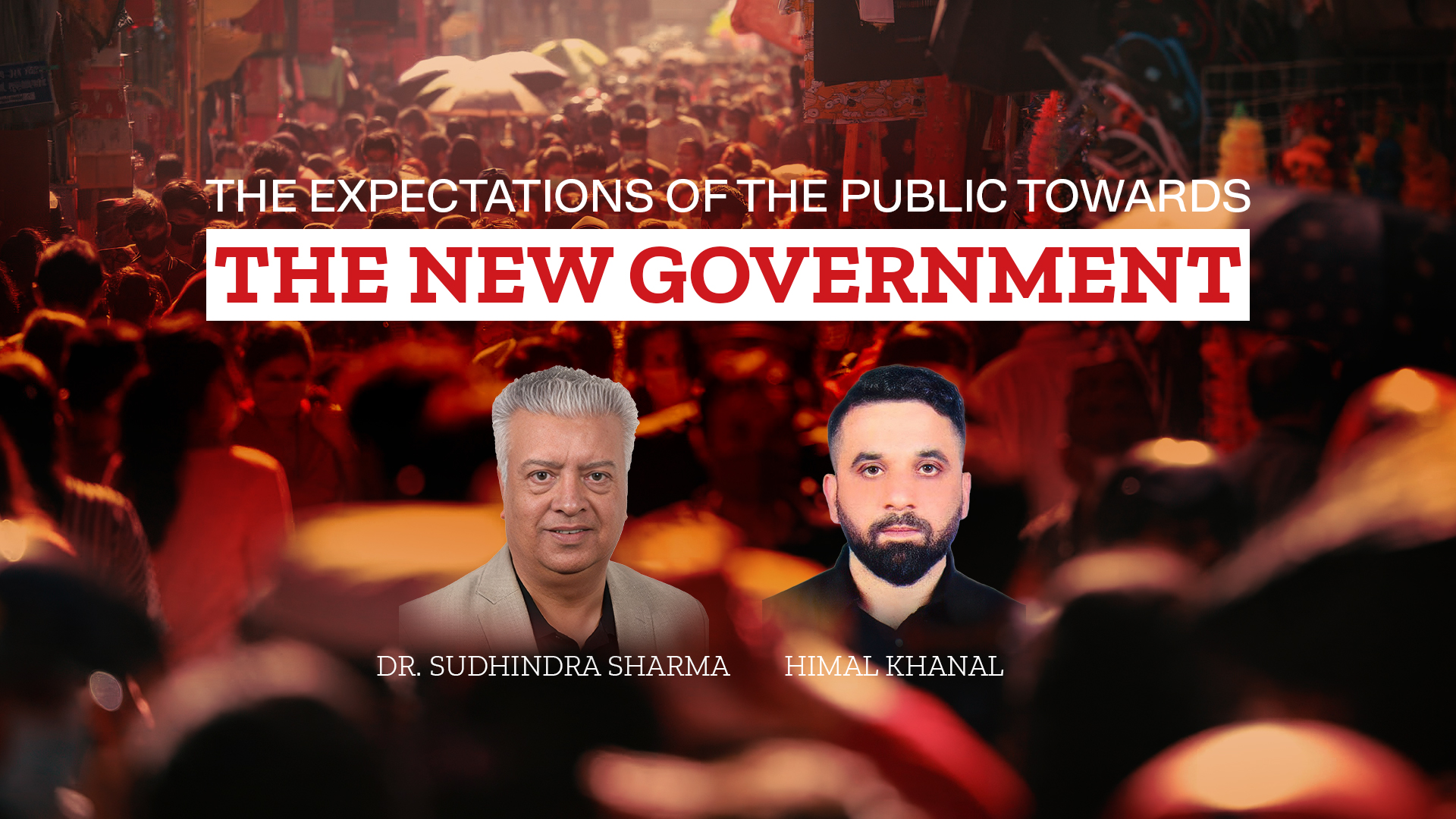
Dr. Sudhindra Sharma and Mr. Himal Khanal[1]
Nepal stands at one of those rare turning points in history where a new epoch begins. The Rastriya Swatantra Party (RSP), securing an overwhelming majority, has reshaped Nepal’s political landscape. At the center of this shift stand Balendra Shah, or Balen, the face the RSP projects as the future Prime Minister of Nepal, and Rabi Lamichhane, its chairman, and the person who brought Balen to RSP’s fold. The long-held dream of Nepalis for a stable government and for a prosperous country is finally around the corner. On March 27 Friday, which happens to be the auspicious day of Ram Navami, the country looks forward to the swearing in of the new government, headed by Balen Shah.
As the adage goes, “with great power comes great responsibility”. The Nepali public has a lot of expectations from the new government. What are these expectations? It is important that the new government take these into account. Likewise, the government that has been formed by securing an overwhelming majority is well placed to revise and update scores of old laws that are in need of dire reform. The reformed laws would not only boost Nepali’s dream of development and progress but also streamline the inconsistencies, contradictions and redundancies.
As the new page of history commences, just as there are immense opportunities, there are challenges and pitfalls. It is important that the new government be fully cognizance of these and put guardrails to prevent these from derailing the government.
The concerns of the public
Scientific public opinion surveys such as The Survey of Nepali People (SNP), a longitudinal public opinion survey that has measured the pulse of the public since 2017, points out that at this juncture, the public identifies four main issues that the government should tackle: (1) corruption (2) employment generation (3) price hike and (4) economic betterment.
There is widespread perception that corruption is endemic in the country. This perception has been increasing in the last few years. There is a perception that the entire system has been rigged and that those with merit and talent do not have a level-playing field and only those either with political connections or with money, have opportunities. In fact, one of the reasons that traditional political parties did poorly in the recent election is the association of their top leadership with corruption. How to uproot corruption from the system itself and ensure a level playing field so that each and every deserving Nepali has chances of success, is something the government needs to prioritize.
However, corruption, especially high-level ones, is not easy to tackle. Corruption is done not by breaking the rules, but in concert with them. It is for this reason that high level government mechanisms such as Commission for the Investigation for the Abuse of Authority (CIAA) have often been unable to charge the high-level political figures. While a reinvigorated CIAA needs to be tasked with opening the high-level corruption cases, other conduits need to be opened up simultaneously. Perhaps the strategy that many countries have adopted in tracking drug cartels, the strategy known as “follow the money trail”, would need to be adopted in tackling high level corruption cases in Nepal.
Whether or not the new government would have made a dent in tackling corruption would be known by Nepal’s ranking in the Corruption Perception Index published annually by Transparency International. If the government makes a dent in tacking corruption, this will be reflected in the country’s scores improving in this index.
Besides the issue of corruption, another expectation of the public, is employment generation and the issue of affordability. Additional hundreds of thousands new jobs need to be created within the country and ensure that the country’s youth do not have to leave for foreign countries for jobs. It needs to be pointed out that for the past several years, especially since COVID, Nepal’s economy has been sluggish, with the economic growth hovering around 3 percent annually in contrast to the neighborhood, which is around 6 to 7 percent. Hundreds and thousands of jobs cannot be created annually unless the economy grows at least around 5 percent annually.
Corruption and lack of employment opportunities within the country, were indeed the fuel that propelled the Gen-Z uprising of September 8 and 9, 2025, besides the need to remove the ban on the social media. One of the reasons RSP did well in the March 2026 national elections was precisely its articulations of these concerns. In addition, while the public saw in RSP new and young faces, the traditional political parties in contrast, had the same tried tested and failed faces of the past 30 years.
Excellent opportunity to reform antiquated laws
Nepal’s lack-luster performance during the last three decades, among others, are due to unstable governments that have been more concerned about preserving coalition governments of the day than passing laws that the country urgently needs. Without a sound legal regime in place, the pace of development has been affected along with the entire governance structure. Be it in widely different domains – from electricity to forestry, from water to roads, from procurement to public safety, the laws are old, antiquated and in need of overhaul.
For example, building infrastructure such as roads, transmission lines, or hydropower projects is extremely difficult due to lengthy and complicated procedures. To develop a single hydropower project, approvals may be required from as many as eight key ministries, 29 departments, and numerous procedural tables and many layers of bureaucracy. Such processes discourage investment and entrepreneurship. This problem is not limited to large projects. Ordinary citizens also face similar challenges, having to go through long and tiring procedures for basic government services. People expect faster, simpler, and more efficient systems to be in place.
A stable government with an overwhelming majority is best placed to revise and modernize the country’s laws. The laws need to be revised taking into account Nepal’s current realities and prospects for the future. At the same time, these should be effective, lead to efficiencies while simultaneously ensuring equity.
International events and their repercussions
Thunderstorms brewing in the Middle East could inadvertently affect the political economic weather in Nepal. There is a growing risk that Nepal would be adversely affected by the ongoing war in the Middle East. If the Strait of Hormuz remains blocked, global petroleum prices will continue to rise. Since much of South Asia’s fuel and fertilizer supplies pass through this route, higher costs would make transportation and everyday goods more expensive in Nepal.
Another major concern is its effect on the remittance economy. Hundreds of thousands of Nepali workers earn their livelihood in the Middle East. If the regional economy falters, due to war engulfing the region, many Nepalis could lose their jobs and be forced to return. This would simultaneously reduce remittance inflows and increase pressure to create jobs within Nepal. The government needs to prepare for this eventuality.
However, every crisis is also an opportunity. Rising fuel prices should, in principle, push Nepal to invest further in renewable energy. Expanding solar power, hydropower, storage and pumped storage projects can reduce dependence on imported fossil fuels. Currently, key sectors like households, industries, and transport rely heavily on either firewood or fossil fuels, with only a small share coming from renewable sources. By promoting clean energy in these sectors, Nepal can move toward energy independence. This would not only reduce vulnerability to global shocks but also support industries, create jobs, and strengthen the overall economy.
Possible Pitfalls
One of the biggest fears among the public is a possible fallout between Balen Shah and Rabi Lamichhane—something the current government must avoid at all costs. Much of RSP’s success has come from the strong cooperation and synergy between the two. A breakdown in their relationship would weaken public trust and jeopardize the party itself, not to mention dashing the hopes of millions of Nepalis.
Such fallout usually does not happen because of dispute between the two leaders. Instead, it often begins when people close to them start expressing grievances against the other side and sowing doubts in the minds of the top leadership. If not handled carefully, the initial murmurs of discontent could escalate into serious misunderstandings. This is why both Rabi Lamichhane and Balen Shah need to be on the guard. They need to be in constant communication. They should manage their “kitchen-circles” deftly.
Another concern of the public is the limited experience of RSP in running the state. As newcomers, they may make mistakes—not out of bad intention, or over confidence but due to sheer lack of experience. If they plan to introduce innovations, they need to proceed carefully. Traditional political parties and the media would be closely watching and waiting for any missteps to pin down the RSP. This makes it important for the Balen government to move ahead with caution and if need be to consult experts in different fields, of which there are a plenty in Nepal.
[1] Dr. Sudhindra Sharma is a Sociologist and Mr. Himal Khanal is a Statistician. Both are associated with Inter Disciplinary Analysts (IDA) (www.ida.com.np) a research and consulting organization based in Kathmandu.