
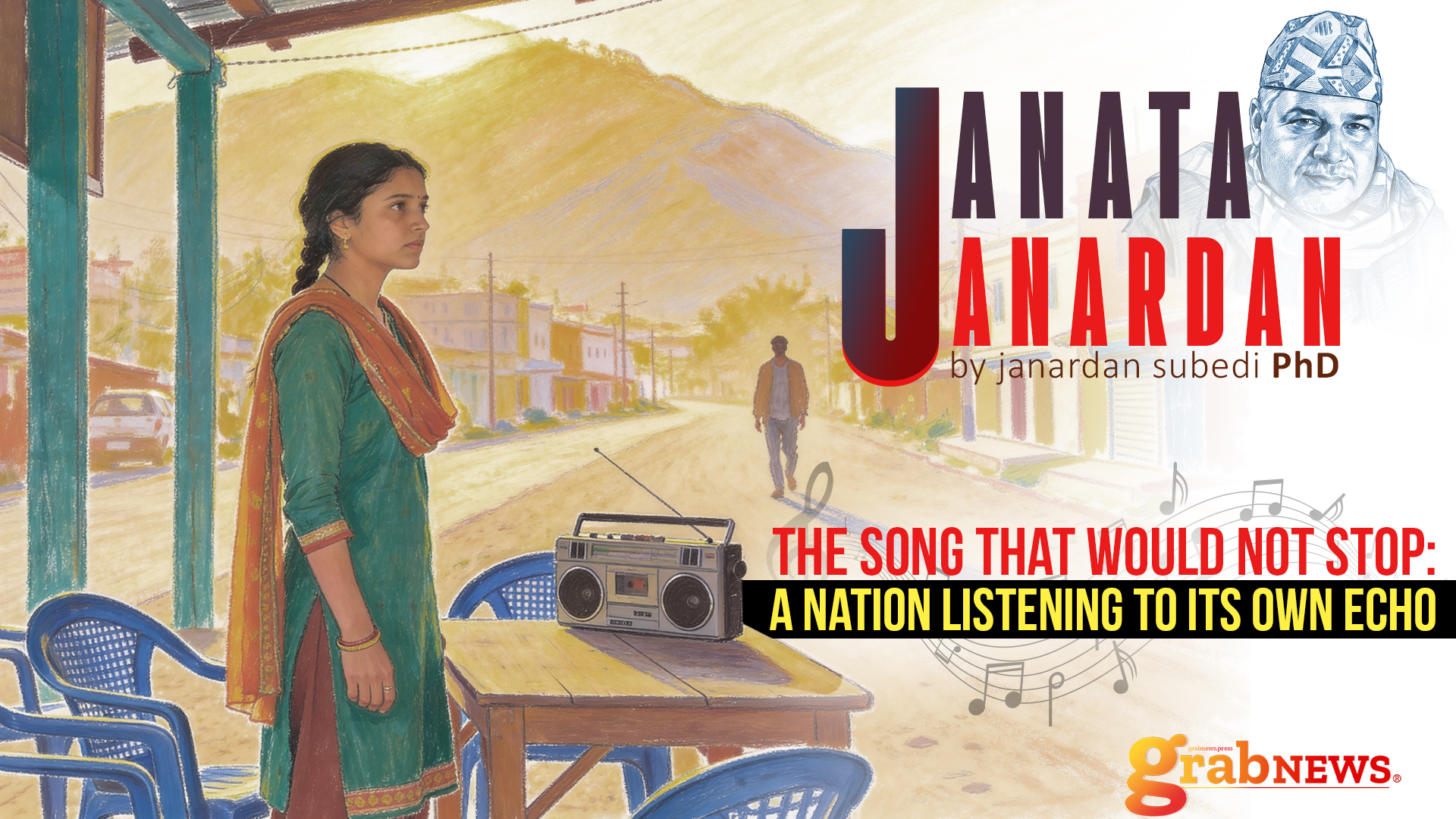

A while ago, somewhere between Bardibas and Janakpur, I stopped at a roadside hotel that my friends insisted was “famous.” In Nepal and much of South Asia, “famous” is not a category for verification. It is a category of repetition. Someone eats there, tells someone else, and suddenly geography becomes reputation. No audits are required. Memory is enough. The place was called “Bauwaa Line Hotel,” near Lalgadh, on a highway where everything moves except certainty. Now its fame had structure. This was not accidental popularity. It was earned within a very specific cultural economy. The menu was unapologetic. Fish arrived heavily spiced, fried until it seemed to have made peace with its own afterlife. Meat dishes followed the same philosophy: slow-cooked, intense, untampered by any concern for restraint. It was food designed not for elegance but for endurance. And then there was the unspoken layer, alcohol. Not advertised and never advertised. In South Asia, nothing important is ever officially acknowledged at the moment it is most obvious. But it was there, in the rhythm of laughter, in the travelers’ loosened posture, in the slow, softening of voices as afternoon moved toward evening.
This is what made it “famous.” Not culinary excellence on a global scale, but cultural functionality on a very local scale. This was a pressure valve. A place where truck drivers, returning laborers, and traveling groups briefly shed the tight collar of social discipline. A space where people ate loudly, spoke freely, and temporarily set aside the architecture of everyday restraint. In South Asia, roadside dhabas are not restaurants. They are sanctioned interruptions to order. And that is precisely why my friends called it “famous.” They were not describing food. They were describing a space of cultural permission, a place where social boundaries could be temporarily loosened, helping the audience empathize with the community’s need for such spaces. We sat on plastic chairs beneath a sky that looked professionally indifferent. My friends ordered generously, as if appetite were a form of cultural validation. I ordered tea, which in Nepal is less a beverage than a diplomatic gesture. Near the counter, a middle-aged couple sat. The man smoked quietly, with the patience of someone who had long accepted that life is not negotiable. A small speaker played a song. And then I heard it clearly.
“तुम्हे हम ढुढ ते हैं, हमे दिल ढुढ्ता है, न अब मन्जिल है कोई, न कोई रास्ता है
अकेले हैं, चले आओ जहाँ हो, कहाँ आवाज़ दें तुमको, कहाँ हो।”
Translated:
“I search for you, yet my own heart searches for me. There is no destination now, no path left.
I am alone. Come to me, wherever you are. From where do I call you? Where are you?”
It is a love song only on the surface. Beneath it lies something more unsettling-a collapse of direction itself, which helps the audience feel the emotional vulnerability of those experiencing displacement and loss of meaning. A young woman came to take our order. I asked for tea. My friends ordered as if they were investing in the establishment’s moral credibility. The song ended. She walked back to the counter. Pressed play again. Then again. And again. For nearly forty minutes, the same song moved through the space. Not loudly. Not dramatically. But persistently, like a thought that refuses to be corrected. At first, it seemed excessive, but it became clear it was necessary. I asked quietly. The couple was her parents. She had been married for three years. Her husband had gone to Dubai for work, a better opportunity, as the phrase goes, a phrase that explains everything and therefore nothing. He left behind a wife and a young child. The song was not merely repeating; it was sustaining a fragile thread of connection, helping the audience feel resilient amid separation. It was sustaining.
While intimate, this moment is not exceptional. It reflects a structural condition. Nearly one-third of Nepal’s population works abroad. Remittances account for roughly a quarter of the national GDP. These figures are often cited as indicators of resilience. And they are. But they also describe something less comfortable. Nepal does not export only labor. It exports presence. Money returns. People do not. Migration, therefore, is not merely economic mobility. It is a structured separation. Families become geographically dispersed. Intimacy is sustained through screens, schedules, and delayed presence. Childhoods are partially digitized. Marriages are partially suspended. This is not a collapse. It is an adaptation. Adaptation produces its own forms of psychological stability. In social psychology, repetitive behaviors under uncertainty are often understood as affective anchoring, which helps individuals cope with emotional instability. The song at Bauwaa Line Hotel was one such loop. It did not resolve the absence issue. It made the absence livable.
Nepal’s current political situation cannot be understood outside this emotional economy, which profoundly shapes social cohesion and collective well-being. A generation shaped by migration is now shaping political expectations and cultural identities, reflecting deep societal transformations. For them, migration is not a policy issue. It is a biography. The question they carry is not whether people should leave. It is whether leaving must remain the default condition for aspiration. Migration has undeniably expanded opportunity. It has funded education, built homes, and broadened social imagination. But it has done so by redistributing presence at scale—growth in exchange for distance. The policy challenge is not abolition. It is recalibration. Can Nepal build an economy where staying is structurally viable rather than emotionally idealized?There are clear directions. Hydropower development, if strategically managed, can generate large-scale domestic employment and stable revenue. Digital services and remote work economies can connect Nepal to global markets without requiring physical travel. Tourism, if diversified beyond seasonal concentration, can create sustained local participation rather than extractive cycles. At the same time, migration itself must be restructured, neither romanticized nor rejected. Stronger labor agreements, improved oversight of recruitment, and diversification of destination countries can reduce vulnerability among those who continue to leave. None of this is immediate, but it is directional. Direction is what policy offers when certainty is unavailable. Even the most coherent national strategy operates within global volatility. A significant share of Nepali workers is employed in the Middle East, where geopolitical instability, oil-based economies, and regulatory shifts shape labor markets. When disruptions occur, they do not appear in headlines first.
They appear as unpaid wages. As delayed calls. The silence stretched longer than anticipated. For the worker abroad, uncertainty is economic. For the family at home, it is an existential matter. To wait for a call without knowing what silence means is to live in a different form of time, one in which hope is continually recalculated. In such conditions, policy is not abstract. It is emotional infrastructure. It is tempting to ask whether leadership can resolve this issue. That is the wrong question. The more accurate question is whether it can acknowledge it without diminishing it. Migration is not a problem to be solved. It is a condition to be governed. It is success and sacrifice at once, expansion and fragmentation simultaneously. Recognizing that contradiction is not hesitation but intellectual maturity. A generation that has lived through absence does not need rhetoric. It needs seriousness.
The roadside hotel near Lalgadh will not appear in development indices or be referenced in economic models or strategic frameworks. Yet it reveals something fundamental. A nation is not sustained by infrastructure alone. The continuity of human presence sustains it. When that presence is systematically dispersed, development takes on a new meaning. Growth becomes measurable, but belonging becomes uncertain. As we prepared to leave, the song continued to play.
“कहाँ आवाज़ दें तुमको, कहाँ हो।”
“Where do I call you from? Where are you?”
It no longer sounded like a personal question. It sounded structural. Not a lament. Not even nostalgia. But a condition quietly organizing a nation learning how to remain itself while scattered across distance. And perhaps that is the most honest description of Nepal today, neither broken nor whole, but still listening for itself in repetition.
[Author Bio: Janardan Subedi is a commentator on society and civilizational thought. In “Janata-Janardan,” he explores contemporary issues through multi-disciplinary perspectives and the voice of the public.]