
 A Critical Analysis by Bhusan Dahal,| July 2026
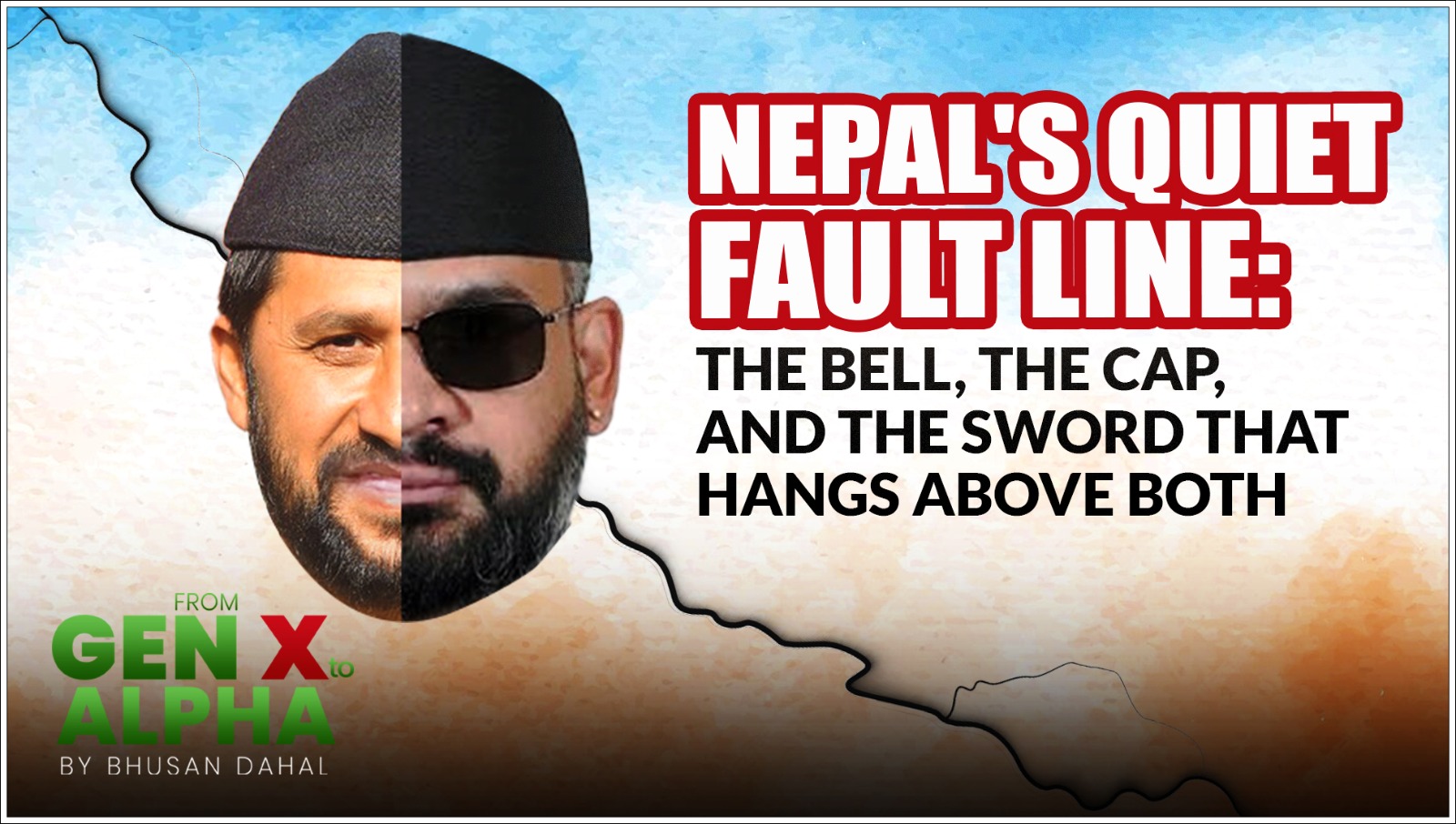
A hundred-plus days into government, Nepal’s youngest-ever prime minister still enjoys the glow of an improbable mandate. Balendra Shah, the rapper-turned-mayor-turned-premier carried the Rastriya Swatantra Party (RSP) to a landslide most analysts didn’t think possible for a four-year-old party. But beneath the popularity, a structural fault line is becoming harder to ignore, and it runs straight through the party’s own rulebook.
What the Chitwan statute actually did
At RSP’s first general convention, held in Chitwan from June 21–27, the party formalised a statute that, on paper, looks like routine housekeeping. In substance, it hands party chair Rabi Lamichhane a lever he did not have before: the power to remove the parliamentary party leader, the position currently held by Shah for failing to follow the chair’s policy direction. A seven-point agreement reached between Lamichhane and Shah in late December had settled that the chair would lead the party while the senior leader would lead the government. The new statute doesn’t erase that division of labour, but it quietly subordinates one half of it to the other. This isn’t the first time RSP’s internal rules have moved in this direction. Convention delegates elected central committee members, but the statute has progressively expanded the chair’s authority from an original design with no direct election of the chair, to one where the chair now nominates roughly a third of the central committee and a majority of office-bearers. Analysts watching the process describe it plainly: the pattern reflects an intentional concentration of power in the office of the chair. Whatever the internal justification, preventing factional splits, integrating smaller merged groups, the effect is the same. The party’s constitutional architecture is being built around one man’s discretion, at the exact moment that man is also fighting off serious criminal allegations.
A sword that keeps un-sheathing itself, then sheathing again
That second half of the story is the judiciary. Lamichhane has spent much of the past year moving in and out of custody and courtroom battles tied to Nepal’s cooperative fraud scandal, cases that once included organised crime and money laundering charges alongside the core fraud allegations. In January, the Attorney General’s Office approved amendments that dropped the organised crime and money laundering counts entirely, while leaving the cooperative fraud case untouched, a move the Attorney General herself defended by saying she believed the earlier charges were retaliatory. That decision has been repeatedly challenged in writ petitions, and the Supreme Court has bounced the matter between benches, issuing show-cause orders, deferring hearings, demanding fresh documentation, and eventually referring the case to a full three-member bench for “deeper legal scrutiny.”
This is the mechanism worth pausing on. Whether or not any individual amendment is legally sound, the recurring pattern, charges filed, then narrowed, then contested, then left pending creates exactly the kind of prosecutorial overhang that governments have historically used, consciously or not, as leverage. A serious case left technically alive, neither dropped nor resolved, functions as a sword hanging over a politician’s head: it doesn’t need to fall to shape behaviour. It just needs to stay unsheathed. Nepal has seen this dynamic before with Lamichhane himself, his citizenship-based disqualification in 2023 removed him from Parliament almost overnight, only for him to return via a decisive by-election win. A politician who has already been legally felled once and re-risen is unlikely to treat a pending money-laundering case as background noise.
Why “strong” governments still fall
Nepal’s own recent history is the best argument against complacency here. The government that preceded this one didn’t collapse gradually, it was toppled by the September 2025 Gen Z protests within days, taking a four-time prime minister down with it. That was Nepal’s 15th change of government since 2012. Strong mandates and popular leaders have not historically been protection against sudden collapse in Nepal; if anything, the pattern shows the opposite, governments that looked entrenched have unravelled fastest when institutional checks (judicial, parliamentary, or intra-party) start pulling in different directions from public opinion. A ruling party that builds a formal mechanism for its chair to unseat its own prime ministerial figure, layered on top of an unresolved corruption case against that same chair, is constructing precisely the kind of latent instability that doesn’t need a protest movement to detonate, it can be triggered from the inside, in a single central committee vote.
The tug of war, honestly stated Strip away the diplomatic language party leaders use in public, “the party stands completely unified”, “working in lockstep” and there is a real asymmetry underneath. Shah brings the image: young, clean, anti-establishment, credited with the momentum that actually won RSP its majority. Lamichhane brings the machine: founder status, unopposed re-election as chair, and now a statute that gives him formal recall power over the very seat Shah occupies. Political observers close to the party have already begun describing a quiet power struggle, visible in disagreements over ministerial appointments, committee chairs, and a minister recalled within days of taking office. This is not yet an open rupture but the ingredients (a legally embattled chair with expanding formal authority, a popular but politically inexperienced premier, and a judiciary whose rulings on the chair’s fate remain genuinely unsettled) are all present simultaneously.
Cautions worth naming plainly
For Lamichhane: consolidating statutory power over the government’s leadership while serious charges remain sub judice invites exactly the suspicion the amendments were meant to dispel, that legal outcomes and political control are being negotiated together rather than separately. Using party machinery to discipline a popular prime minister, however procedurally legitimate, risks converting a legal cloud into a full-blown legitimacy crisis for the party as a whole. For Shah: an untainted image is an asset, not an armour. Governing without deep political experience, inside a party whose bylaws now formally subordinate his position to the chair’s policy direction, means his popularity alone won’t protect the mandate if internal rules are ever invoked against him. Distancing himself from Lamichhane’s legal troubles, as analysts have suggested he’s expected to do, is easier said than executed when the party’s own convention has just tied their fates more tightly together, not less. For Nepal: a country that lost 76 lives to street protests less than a year ago, that has cycled through fifteen governments since 2012, and whose youth unemployment has driven thousands abroad daily, cannot easily absorb another round of political instability manufactured from within a party that voters chose specifically to escape that cycle. The RSP was the vessel millions of young Nepalis poured their hope into. If that vessel splits over an internal tug of war between its chair and its prime minister, one shadowed by unresolved fraud allegations, the other carrying a mandate he didn’t fully anticipate, the cost won’t just be borne by Lamichhane or Shah. It will be borne by a generation that is still deciding whether democratic politics in Nepal can actually deliver, or whether it’s simply due for its sixteenth reset.
About the Author, Bhusan Dahal is a veteran Nepali television personality, filmmaker, and media professional with over three decades in the industry. He hosts The Bravo Delta Show on grabNEWS, and has directed music videos for some of Nepal’s most celebrated artists. He is also known as the director of Kagbeni, his debut feature film. He writes regularly on social, cultural, and political issues that he believes the younger generation of Nepalis must understand, own, and carry forward.