
By : Janardan Subedi
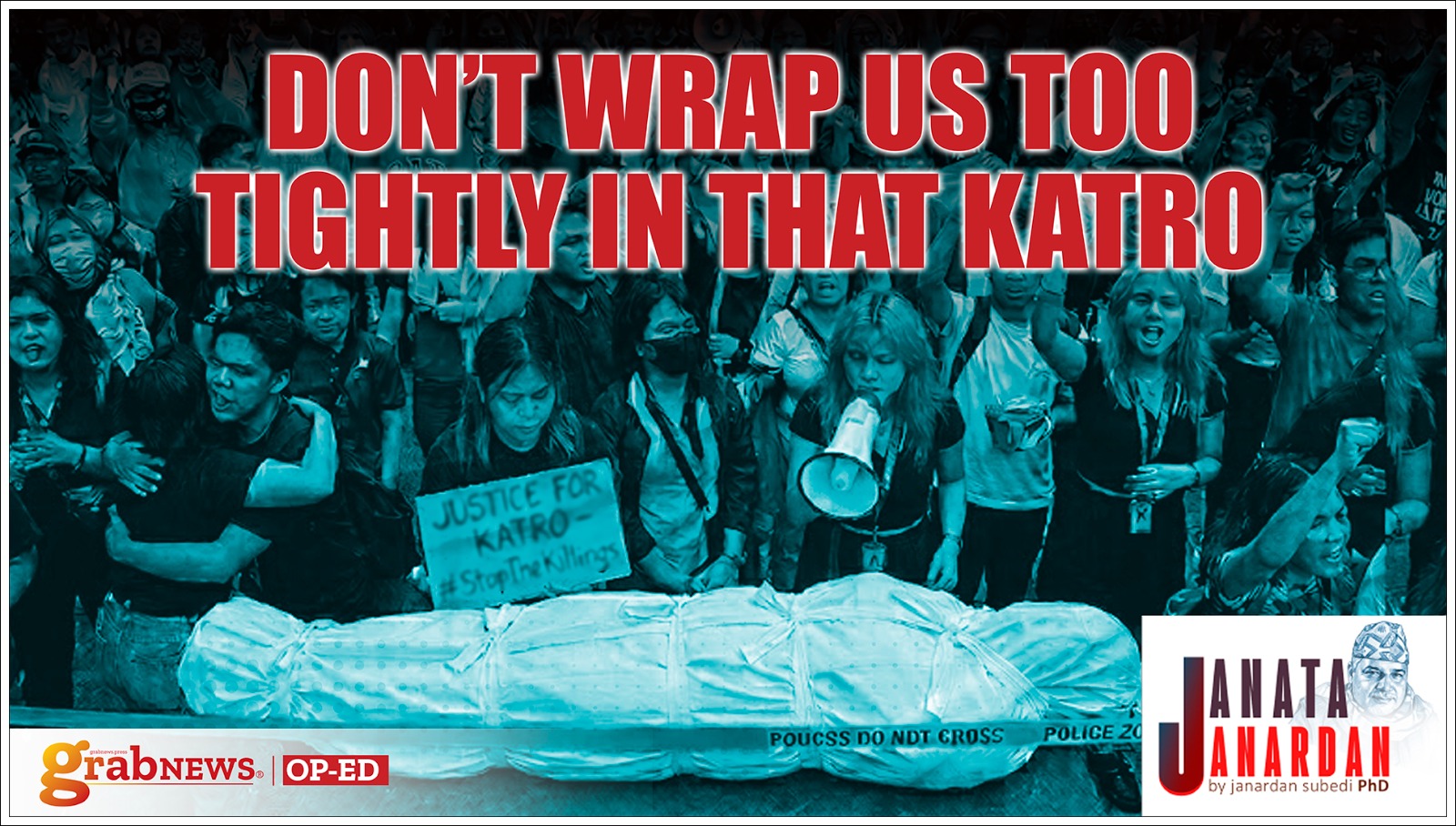
 “Don’t wrap my body too tightly in that Katro. I promise I will never come back.”
That sentence sounds different in Nepal after September 8 and 9, 2025. Before those days, it sounded philosophical. After those days, it sounds like a warning.
On September 8 and 9, widely reported accounts indicate that seventy-six people lost their lives in nationwide violence triggered by the Gen-Z protests. The precise circumstances, responsibility, and sequence of those deaths remain under investigation and debate. But the broader reality is not in dispute: Nepal crossed a psychological threshold as young citizens began dying in the streets while demanding dignity, accountability, and institutional reform.
That moment cannot be neatly folded into ritual. Yet ritual is precisely what Nepal excels at. The Katro helps with that. In Hindu funeral practice, the Katro symbolizes detachment, the final acknowledgment of impermanence. It is a cloth of farewell, dignity and closure.
But in Nepal’s political and social life, the Katro has quietly become a habit. This reflex shields us from confronting painful truths and fosters frustration and concern about systemic stagnation. We wrap the dead carefully because we often do not know how to confront the living with honesty.
Nepal has become extraordinarily efficient at this. Young people die. The nation mourns. Television lowers its standards. Political leaders issue carefully calibrated statements that resemble administrative obligations more than moral reckoning. Social media briefly erupts in grief. Candles appear. Hashtags circulate. Then silence returns. The system remains unchanged.
The Gen-Z movement did not emerge suddenly. A social media ban did not simply trigger it, though that decision served as the immediate spark. Beneath it lay years of accumulated frustration, economic stagnation, institutional fatigue, political repetition, and a widening gap between public rhetoric and lived reality.
The anger was already present. It was waiting in airport queues filled with departing students. In consultancy offices, IELTS preparation has become a national industry. In hostel rooms, where migration plans are discussed more seriously than political futures. In households where parents quietly accept that their children’s futures lie elsewhere. This was not spontaneous combustion. It was stored pressure and when the state responded with force, including the use of live ammunition in reported confrontations, that pressure turned into a rupture. What followed was not simply a protest. It was recognition. Recognition that an entire generation no longer believes the political language of the past can describe its present.
For decades, Nepal’s political discourse rested on deferred promises. Democracy was always arriving. Inclusion was always being implemented. Prosperity was always on the horizon. Federalism was always stabilizing. Reform was always underway.
Everything in Nepal was perpetually “coming.” Meanwhile, everyday life kept tightening. A society can endure hardship longer than repeated disappointment. The Gen-Z movement marked the breaking point of that endurance. Not only anger, but exhaustion. A generation no longer willing to romanticize sacrifice as a substitute for results.
Like all mass movements, it was not internally uniform. It contained contradictions, competing agendas, moments of confusion, and opportunistic interpretations. Yet these complexities do not erase the central truth: a large segment of Nepal’s youth withdrew emotional consent from the traditional political order.
That withdrawal is more consequential than any single protest could be. Governments can survive opposition. What destabilizes systems is the loss of belief that the system understands reality at all.
Subsequent political realignments, including the rise of new leadership styles and figures, cannot be understood apart from this rupture. They are not isolated events but expressions of a deeper shift in political sentiment. The old order did not merely lose votes. It lost emotional authority, which is far more difficult to recover.
Nowhere is this alienation more evident than among Nepal’s youth. This generation is more educated, more globally connected, and more aware of comparative possibilities than any before it. It is also more disillusioned.
Previous generations often endured hardship, believing that endurance itself carried meaning that suffering would eventually translate into national transformation. This generation increasingly asks a more difficult question: For what? For which future? For whose system?
That question now sits at the center of Nepal’s political life, even when it is not spoken aloud. It appears in migration statistics, in declining civic trust, in the quiet resignation of everyday conversations, and in the growing emotional distance between citizens and institutions.
And the Katro returns not only as a ritual but also as a powerful metaphor for society’s tendency to cover up unresolved truths rather than confront them directly. Because Nepal’s deeper pattern is not simply one of tragedy, it repeatedly ritualizes tragedy without transforming it into meaningful institutional change, highlighting a recurring cycle of mourning and inaction.
We mourn collectively.
We speak eloquently.
We remember briefly.
And then we resume our familiar patterns.
The ritual is complete.
The reflection is not.
In this sense, the Katro does not only cover the dead. It also covers unfinished questions. It allows societies to feel a sense of closure without achieving understanding. That is why it matters politically. A society that continually turns structural crises into ceremonial closure risks losing its capacity for genuine reform and progress. Grief becomes manageable. Outrage becomes scheduled. Disappointment becomes normalized. Eventually, moral shock itself begins to fade.
That is perhaps the most dangerous condition of all: when citizens are no longer surprised by preventable tragedies, risking moral complacency and apathy.
The seventy-six deaths linked to the September events should not be absorbed into the long archive of national memory as another episode of sorrow without consequence. They should remain politically and morally uncomfortable, not because discomfort is desirable, but because it prevents premature closure.
Otherwise, Nepal risks repeating a familiar ritual: carefully wrapping unresolved failures, carrying them with dignity to the cremation ground, and returning unchanged. None of this is an argument for despair. It is an argument for clarity, encouraging us to see beyond ritual and recognize the path toward meaningful change.
Nepal does not lack mourning. It suffers from a surplus of ritual and a shortage of institutional learning. The challenge is not to stop grieving. It is to ensure that grief does not become a substitute for reform. The real danger is not instability. It is an adaptation.
A society can adapt to almost anything: weak institutions, uneven accountability, recurring disappointment, even preventable loss of life. Yet adaptation without reflection leads to moral erosion. Moral erosion is slow, quiet, and often invisible until it becomes structural. This is why the events of September 8 and 9 cannot be allowed to settle too quickly into narrative comfort. They must remain unsettled. Not because societies should live in perpetual grief, but because premature closure prevents learning.
“Don’t wrap my body too tightly,” warns the sentence. Do not wrap the truth too tightly either. Do not wrap institutional failure in ceremonial language. Do not wrap generational exhaustion in patriotic abstraction. Do not wrap political responsibility in symbolic mourning. Because what is wrapped too tightly does not disappear. It simply stops being seen. And what is no longer seen is easily repeated. That is the quiet danger Nepal faces. Not that it does not remember. But it remembers in ways that make it too easy to forget.
The Katro, then, is not only for the dead. It is for the living system that prefers dignity to diagnosis, ritual to reform, and closure to confrontation. Unless that changes, Nepal will continue to do what it has done too well for too long: mourn beautifully and learn incompletely.
[Author Bio: Janardan Subedi is a commentator on society and civilizational thought. In “Janata-Janardan,” he explores contemporary issues through multi-disciplinary perspectives and the voice of the public.]