
 Analysis by Bhusan Dahal | June 10, 2026
A Crisis of Identity, Accountability, and Misdirection
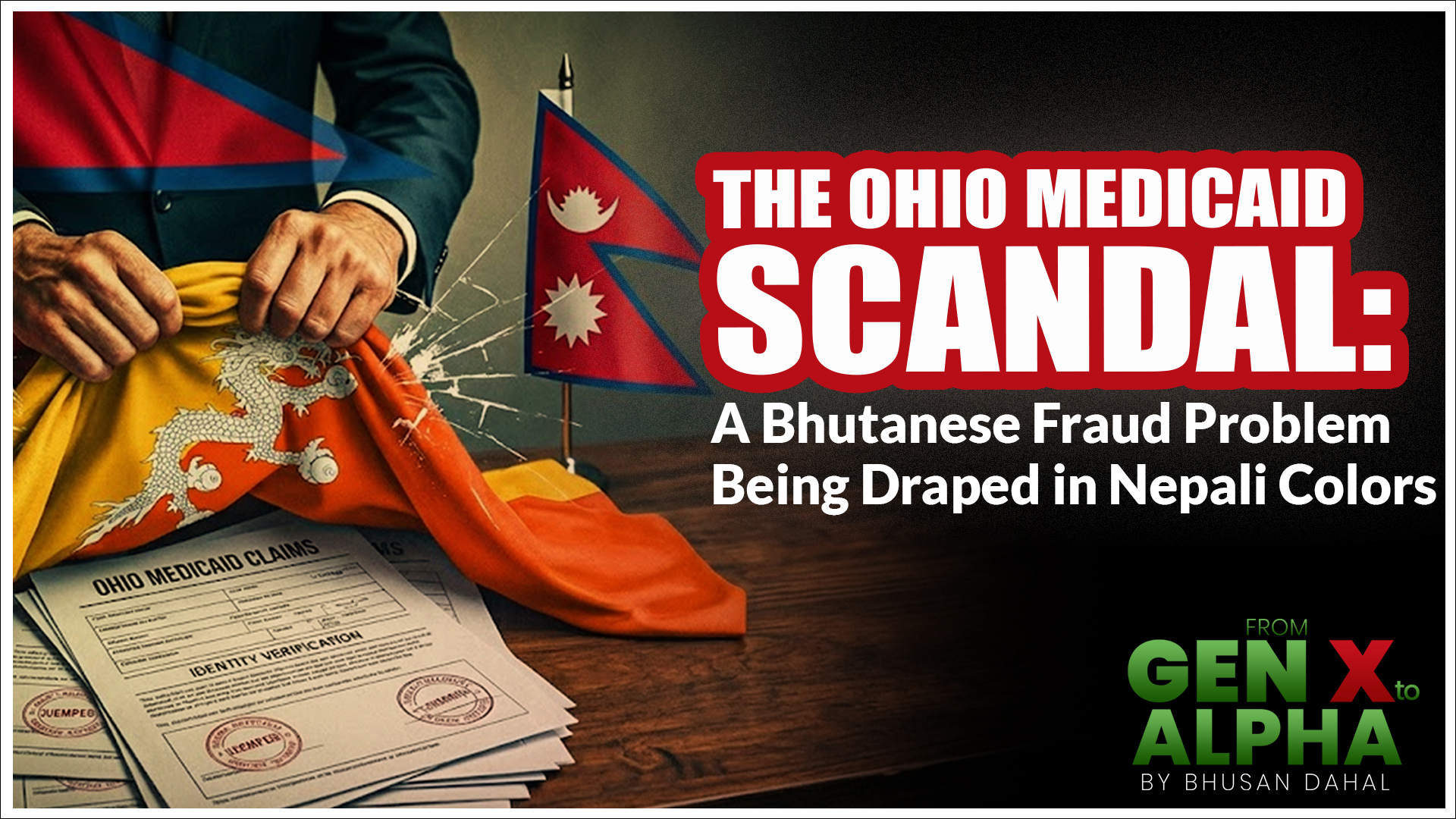
The United States is currently gripped by a sprawling fraud investigation centered on Ohio’s Medicaid waiver programme. At the heart of the scandal are Bhutanese refugees resettled in American cities yet the backlash, the confusion, and much of the reputational damage is being absorbed by a very different people: Nepalis. Understanding this distinction is not a matter of ethnic hair-splitting. It is a matter of justice, historical accuracy, and protecting an innocent diaspora from becoming collateral damage in a fraud they did not engineer.
Who Are the Bhutanese Refugees — And Who Are They Not?
The first, most critical clarification is this: the Bhutanese refugees at the centre of this controversy are not Nepalis. They are Lhotshampas a heterogeneous Bhutanese people of Nepali descent whose first language is Nepali, and who are estimated to comprise around 35% of Bhutan’s population.The distinction matters enormously. People of Nepali origin began settling in the uninhabited areas of southern Bhutan in the 19th century, and the term “Lhotshampa,” meaning “southern borderlanders” in Dzongkha, came to be used by the Bhutanese state to refer to this population. Over generations, these people became Bhutanese citizens not Nepalis. They were expelled from Bhutan by the Bhutanese state, not Nepal. They lived in Nepal’s refugee camps as guests of the Nepali government, not as Nepali citizens.
In 1988, the Bhutanese government census recategorised people with Nepali heritage as illegal immigrants. Local Lhotshampa leaders responded with antigovernmental protests demanding citizenship. In 1989, the government mandated the national dress code for all citizens and removed Nepali as a language of instruction in schools in favour of Dzongkha, the national language. This state-engineered ethnic cleansing drove over 100,000 people into tent camps along Nepal’s eastern plains, places like Jhapa and Morang where they waited for over a decade before third-country resettlement began.
In 2006, the United States, along with Australia, Canada, Denmark, the Netherlands, New Zealand, Norway, and the United Kingdom, agreed to resettle the Bhutanese refugees. By 2015, over 100,000 of them had been resettled in third countries, with the vast majority over 84,000 heading to the United States. Nepalis, by contrast, are citizens of the sovereign Federal Democratic Republic of Nepal. They migrated to the United States through legal visa channels work visas, student visas, diversity visas, and family reunification. The two groups share a language. They do not share a nationality, a history of statelessness, or the legal status of “refugee.” Conflating them is as careless as confusing Americans with Australians because both speak English.
The Ohio Fraud: What Is Actually Known
A conservative American outlet reported that Bhutanese and Nepali immigrants are behind what it described as a billion-dollar Medicaid fraud scheme in Ohio, specifically involving the state’s home health waiver programme. The Daily Wire’s reporter Luke Rosiak analysed publicly available Medicaid payment data and found two distinct patterns. The first was a shell company scheme: 288 home health companies in Columbus sharing the same addresses, many clustered in seven mostly empty office buildings along state route 168. These companies collectively billed the US government more than $`250 million in Medicaid funds between 2018 and 2024. The House Committee on Oversight Task Force held its first hearing on Ohio’s Medicaid waiver fraud on June 3, 2026. Chairman Brandon Gill stated that taxpayers had lost $ 1.2 billion to “foreign fraudsters” and that the Bhutanese and Somali communities committed a large portion of home health Medicaid fraud in Ohio. At the hearing, one witness claimed that a Bhutanese nonprofit advocacy group tied to and funded by a home healthcare entrepreneur had recently bussed 15,000 Bhutanese participants to a community gathering using Medicaid transport vans, because nearly everyone present allegedly had their own Medicaid company. Prosecutors identified 14 luxury vehicles and almost 30 million from behavioural health services in 2024 and 2025. On June 4, 2026, Governor Mike DeWine announced that the Ohio Department of Medicaid had suspended payments to 49 Medicaid home health providers displaying concerning billing patterns. There is, by all credible accounts, genuine and significant fraud here. The question is who bears responsibility and who is being made to bear it unjustly.
The Cultural Camouflage: High-Budget “Ethnicity Over Nationality” Narratives
Here is where soft power enters the picture and where the Nepali diaspora needs to pay sharp attention. In recent years, a particular genre of content has proliferated across the Nepali-language internet: lavish cultural programmes, reality shows, and community events that lean heavily on a seductive premise that when you live abroad, your nationality becomes irrelevant. What binds us, goes the argument, is ethnicity and shared cultural roots. The Bhutanese refugees, who speak Nepali, celebrate Dashain, and sing Nepali songs, fit naturally and emotionally into this narrative. The message, amplified by well-funded community events, is essentially: we are the same people.
This framing is not merely sentimental. It functions as a strategic identity merger that serves specific interests. When a community responsible for large-scale government fraud successfully positions itself as simply another branch of the Nepali family tree, the reputational and legal consequences of that fraud are distributed across the entire tree. The shell companies in Columbus do not carry Bhutanese flags. They carry Nepali-sounding names, Nepali speaking operators, and a community identity that American politicians and journalists cannot easily disaggregate. The innocent Nepali worker in Ohio the nurse, the IT professional, the student, the restaurant owner or the doctor suddenly finds themselves grouped with fraudsters they have never met, in a scheme they took no part in, under a label broad enough to swallow everyone.
The Fake Refugee Scam in Nepal: The Same Network, An Earlier Chapter
The Ohio Medicaid fraud does not exist in isolation. It is connected, by personnel, by networks, and by modus operandi, to one of Nepal’s most explosive corruption scandals: the fake Bhutanese refugee scam. Nepal was shaken by revelations that high ranking government figures had participated in a fraudulent scheme involving Nepali nationals posing as Bhutanese refugees in order to orchestrate their resettlement to the United States. This was not small-time opportunism. The chargesheet detailed how defendants collected Rs 288.17 million from 115 documented victims ranging from Rs 200,000 to Rs. 4 million each promising to send them to the US disguised as Bhutanese refugees. The arrests were extraordinary by Nepali standards. On May 10, 2023, former Home Minister and Nepali Congress politician Bal Krishna Khand was detained for his complicity in the trafficking of Nepali individuals as Bhutanese refugees overseas. On May 14, Top Bahadur Rayamajhi, former secretary of the Communist Party of Nepal (UML) and former Energy Minister, was arrested after being on the run for more than ten days. Cases were filed against 30 individuals, including former Deputy Prime Minister Top Bahadur Rayamajhi and former Home Minister Bal Krishna Khand. All were prosecuted for four types of crimes: treason, organised crime, fraud, and forgery.
But justice moved unevenly. While those in judicial custody included former ministers and senior officials, 12 of the accused remained on the run and two were released on bail. Key fugitives continued to evade accountability for years. The Central Investigation Bureau relaunched the investigation in late 2025 following the arrest of a new fugitive middleman, Niranjan Kumar Kharel, with officials announcing the probe had “formally moved to the upper level,” targeting powerful political and bureaucratic actors still at large. Multiple Nepali parliamentarians, including members of both the ruling coalition and the opposition, claimed that the FBI was also investigating the issue at the international level. This suggests that what began as a domestic Nepali fraud case had transatlantic dimensions, dimensions that connect directly to the communities and systems now implicated in the Ohio Medicaid scandal.
The Scam Is Bhutanese — Call It What It Is
The Bhutanese refugee community in Ohio is not a monolith, and condemning an entire population for the crimes of a networked minority is both unjust and counterproductive. Community leaders like Tika Adhikari have called the broad generalisation a “dangerous disinformation campaign” and argued that naming a whole community is “not a civilised way of dealing with an issue.” These voices deserve to be heard. However, hearing those voices does not mean erasing the ethnic and national specificity of who is actually running the fraud networks under investigation. The perpetrators of the Ohio Medicaid scheme are, by all investigative accounts, Lhotshampa Bhutanese refugees not Nepali immigrants. They came to Ohio as refugees under resettlement programmes designed to shelter victims of ethnic cleansing. The fraud they allegedly built is a betrayal of that generosity and a betrayal of every genuine refugee who arrived with clean hands.
Calling this a “Nepali scam,” allowing it to drift under the cultural umbrella of “people of Nepali origin,” or burying it in ethnic solidarity narratives does a profound disservice to Nepal, to the Nepali diaspora, and ultimately to the truth.
What the Nepali Diaspora Must Understand
The Nepali diaspora in Ohio, in the US broadly, and globally is being asked, often wordlessly and through cultural osmosis, to absorb blame that belongs elsewhere. The extravagant community events, the cultural programming that emphasises shared ethnicity over distinct nationality, the social media content of young men on private jets who are then revealed to be central figures in government fraud investigations, these are not incidental. They form a pattern of identity laundering. Nepalis have built their overseas reputation on hard work, education, military service, and honest labour. That reputation is a national asset. It should not be surrendered to cover the tracks of a fraud network that happens to speak the same language. The fake Bhutanese refugee scam in Nepal with its still-fugitive ringleaders, its political patrons, and its transnational reach and the Ohio Medicaid scandal are chapters of the same story. A story about a network that has exploited legal systems, welfare systems, and the goodwill of host nations. The Nepali people, at home and abroad, deserve to be spectators of that story not characters written into it by association. Accountability requires precision. Justice requires distinction. And the Nepali diaspora’s good name requires both.