
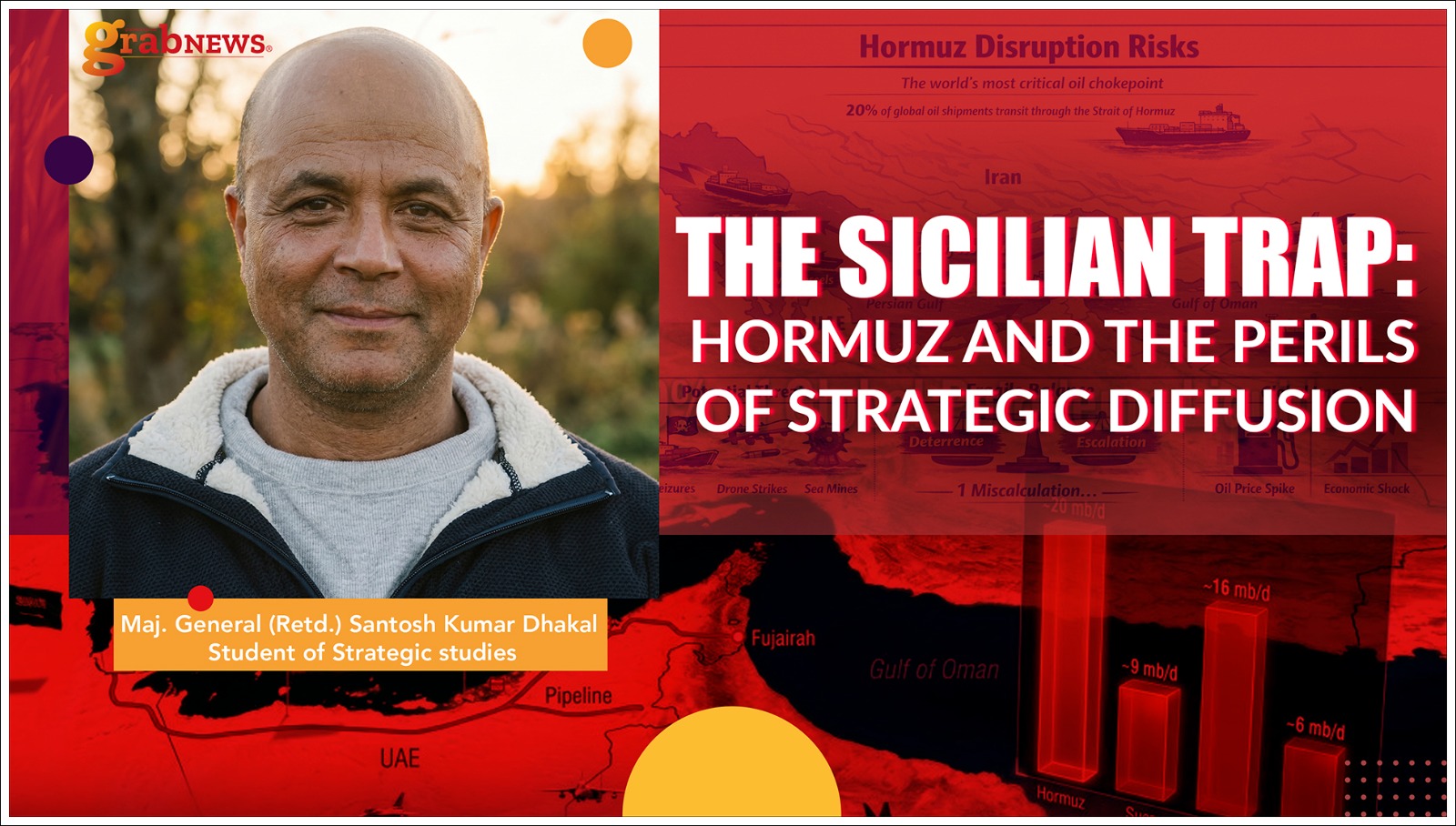
History rarely repeats itself, but its strategic dilemmas possess an uncanny persistence. In late May 2026, fragile U.S.-Iran negotiations continue over reopening the Strait of Hormuz. Following earlier escalations, Iranian actions — ranging from sporadic transits and toll disputes to IRGC-coordinated movements and declarations of control — have kept energy markets unsettled, restricting daily traffic through the Strait and sustaining elevated oil prices. These developments underscore a familiar pattern: a weaker actor leveraging geography and asymmetry to impose costs on a stronger power stretched across multiple theaters.
The United States is not Athens, and Iran is not Syracuse. Yet Thucydides’ History of the Peloponnesian War (431–404 B.C.) illuminates a timeless truth about strategy: great powers often falter not from insufficient strength, but from failures of judgment in distinguishing manageable disruptions from existential drains. Athens ultimately lost its edge in Sicily because that distant campaign consumed resources and attention desperately needed closer to home. As Washington balances its Gulf commitments against competing strategic priorities in the Indo-Pacific and Europe, the risk of a similar miscalculation remains real.
Thucydides on Strategy: Realism, Foresight, and the Primacy of Judgment
Thucydides viewed strategy as the exercise of gnōmē — prudent judgment and foresight — under the enduring pressures of “fear, honor, and interest,” which he identified as the primary motives driving states to war. He highlighted structural causes, such as the rise of Athenian power alarming Sparta, but stressed that leaders’ choices ultimately shape outcomes. Effective strategy aligns ends with means, understands adversaries’ constraints, and resists the passions that cloud deliberation.
Thucydides praised Pericles’ defensive, naval-focused approach while warning that democracies are especially vulnerable to demagogues and collective passions. “The strong do what they can and the weak suffer what they must,” he recorded in the famous Melian Dialogue, where Athenian envoys bluntly asserted raw power politics over justice. This reflects a shift from Periclean restraint to imperial confidence, where strategic discipline gives way to dominance and hubris. Yet Thucydides’ broader narrative also shows that even the strong remain vulnerable: weaker actors can impose indirect costs, and overconfidence can erode great powers from within. Strategy, for Thucydides, is not a science of formulas but an art of judgment amid uncertainty.
Pericles’ Strategic Doctrine: Restraint, Sea Power, and Sustainable Defense
Pericles provides the most coherent example of strategic judgment in practice. As the architect of early Athenian strategy, he emphasized restraint, naval power, and avoidance of overextension. Recognizing Spartan superiority on land and Athens’ advantages in finance and navy, he advocated a strategy of “defense within the walls.” Athenians would abandon the Attic countryside during Spartan invasions, shelter behind the ‘Long Walls’ connecting the city to Piraeus harbor, and rely on the fleet for resupply, coastal raids on the Peloponnese, and protection of the empire’s maritime lifelines.
Pericles urged his citizens to “wait quietly, to pay attention to their navy… and not to seek to expand their empire during the war.” The goal was survival and sustainability rather than conquest or glory. By conserving resources, exploiting maritime strengths, and avoiding decisive land battles where Sparta held the edge, Athens could outlast its rival economically and wear down its will through selective pressure. This was a strategy of asymmetric advantage and disciplined conservation: use sea power for raids and empire protection while minimizing exposure. Thucydides praised this approach, noting that Athens prospered under it until Pericles’ death from plague in 429 B.C. Successors abandoned this restraint, succumbing to ambition and leading the city toward catastrophe. Pericles understood that strategy must serve the polity’s long-term viability, not fleeting opportunities.
The Geometry of Vulnerability: Brasidas and the Indirect Approach
If Pericles represented restraint, Brasidas embodied the indirect approach. Facing Athenian naval supremacy, the innovative Spartan commander avoided direct confrontation with Athens’ core strengths. In 424 B.C., he led a daring northward campaign into Thrace, blending rapid movement, shrewd diplomacy promising autonomy to subject cities, and moderate surrender terms that encouraged voluntary defections. He exploited local grievances against Athenian rule rather than relying on brute force alone.
At Amphipolis — a vital Athenian colony controlling timber for shipbuilding, silver mines, and key trade routes — Brasidas seized a bridge in harsh winter conditions, captured the city through surprise and favorable terms, and later defeated an Athenian relief force under Cleon through tactical improvisation and personal leadership from the front. Though mortally wounded, his success forced Athens to divert significant resources far from its center, threatening what it could not afford to lose and shifting the war’s overall geometry.
This Brasidean logic finds powerful echoes in modern strategic thought. B.H. Liddell Hart, traumatized by the attritional slaughter of World War I, articulated the ‘indirect approach’ as the path to decisive results. Rather than battering the enemy’s strongest points, one advances along lines of least expectation to dislocate their psychological and physical equilibrium. Surprise, maneuver, and attacks on vulnerabilities — rear areas, supply lines, alliances, or will — achieve dislocation more effectively than annihilation. “Effective results in war,” Liddell Hart wrote, “have rarely been attained unless the approach has had such indirectness as to ensure the opponent’s unreadiness to meet it.”
J.F.C. Fuller’s Plan 1919 extended this thinking into mechanized warfare. Envisioning a future offensive against Germany, Fuller proposed using fast medium tanks for deep penetrations into rear areas to disrupt command centers, supply lines, and communications, supported by aircraft bombing. The goal was paralysis through confusion and panic — a “lightning thrust” to shatter cohesion before main forces fully engaged. Though never executed, it prefigured blitzkrieg and emphasized indirect effects on the enemy’s decision-making and logistics.
Iran applies a contemporary Brasidean/Liddell Hartian logic, amplified by modern tools. Unable to match U.S. conventional power, Tehran uses proxies, drones, missiles, maritime threats, and calibrated ambiguity in Hormuz to raise insurance premiums, spike energy volatility, strain alliances, and test democratic patience. This is indirect pressure: not symmetric battle but dislocation of the opponent’s economic and political equilibrium.
In today’s drone-saturated environment, large-scale traditional maneuvers like Fuller’s envisioned tank thrusts or Brasidas’ turning movements are often impractical or dangerously escalatory due to precision weapons, surveillance, and escalation risks. Yet the principle endures: fracturing the adversary’s OODA loop (Observe-Orient-Decide-Act) through rapid, unpredictable actions. Drone swarms, loitering munitions, proxy networks, and hybrid maritime threats create cognitive overload, force constant adaptation, and disrupt coherent responses — achieving dislocation without massed formations. Success depends on innovation speed and the ability to present multiple dilemmas that paralyze decision-making. Iran’s tactics in the Gulf exemplify this evolution: persistent low-level harassment that keeps stronger powers off-balance without triggering full-scale war.
Such pressure demands resolute management — credible deterrence, allied coordination, and selective enforcement of navigation rights — but not obsessive reaction that hands the disruptor precisely the leverage it seeks.
Domestic Fragility and Strategic Caution: Sparta’s Helot Constraint
Sparta’s strategy was inseparable from its deepest vulnerability: ‘The Helots’. This large subjugated population, vastly outnumbering Spartan citizens, powered the agrarian economy but posed a perpetual risk of rebellion. Fear of internal upheaval fostered Spartan conservatism, reluctance to dispatch elite Spartiates far from home, and preference for limited expeditions. Brasidas innovated by recruiting 700 Helots for his Thrace campaign — removing potential agitators from Laconia while bolstering his forces, with many later earning freedoms. Yet the underlying constraint remained: external ambition always risked inviting domestic collapse. Thucydides shows how internal fragility profoundly shapes external strategy.
America faces analogous “Helot-like” constraints in the 21st century: ballooning national debt, industrial base limitations, fragile supply chains, demographic pressures, and deepening political polarization. These do not threaten literal revolt but curtail strategic freedom of action. Prolonged secondary commitments in the Gulf risk exacerbating fiscal strain, diverting industrial capacity from critical needs like shipbuilding and munitions production, and deepening domestic divisions over endless foreign engagements. Pericles’ doctrine of restraint reinforces the imperative to guard foundational strengths while addressing threats efficiently and indirectly.
The Seduction of Opportunity: Alcibiades and the Lure of Expansion
Alcibiades, by contrast, represents the opposite strategic impulse. A brilliant and charismatic Athenian statesman and general, he embodied a confident and expansionist vision of Athenian power at its height. Where Pericles emphasized restraint and consolidation, Alcibiades emphasized ambition, opportunity, and the projection of Athenian influence into distant theaters such as Sicily.
His strategic doctrine was driven less by constraint than by possibility. He believed Athenian power should be actively extended rather than cautiously conserved, and that opportunities for expansion should be seized before they vanished. Strategy, in this sense, became less about managing risk than about maximizing advantage wherever it appeared attainable. In 415 B.C., Alcibiades persuaded the Athenian assembly that conquering Sicily would bring immense wealth, strategic position in the Mediterranean, and a decisive shift in the balance against Sparta. “Why not?” became the rallying cry.
The consequence was profound. The Sicilian Expedition swelled into a massive armada that devolved into catastrophe — over 100 ships lost, tens of thousands of men killed or captured. What began as an attractive opportunity became an obsession, squandering irreplaceable resources while Sparta regrouped and exploited Athenian overextension. Thucydides contrasts this with Periclean prudence, showing how ambition untethered from judgment leads to miscalculation and self-inflicted wounds.
America confronts parallel Alcibiadean temptations today. The Middle East offers perpetual urgent demands: proxy conflicts, maritime security operations, sanctions enforcement, and crisis diplomacy. Each feels morally weighted and strategically necessary in the moment. Yet every carrier group committed to Gulf escorts, every munition expended reactively, and every policymaker hour consumed by Hormuz negotiations carries significant opportunity costs in the decisive Indo-Pacific theater, where long-term competition with China will define the century. Liddell Hart and Fuller remind us that indirect methods can manage secondary theaters efficiently without direct, resource-consuming engagements.
The Imperative of Restraint: Nicias and Strategic Prioritization
Nicias stood as the voice of disciplined realism against Alcibiades. An experienced general, he warned that Athens was already locked in a grinding contest with Sparta. Resources — ships, manpower, treasure, and political cohesion — were finite. A distant adventure risked squandering the very advantages sustaining the empire. Not every tempting objective was necessary; true strategy lies in choosing what not to do. Ignored in Sicily, his counsel proved prophetic.
U.S. policy toward Iran should reflect this Nicias-like discipline combined with Periclean restraint: manage disruptions through efficient deterrence, burden-sharing with Gulf partners and Israel, targeted diplomacy, and selective pressure — rather than turning Hormuz into a modern Sicilian quagmire that drains focus from higher priorities.
Navigating the Strategic Triangle
Thucydides, Pericles, Brasidas, Alcibiades, Nicias, Liddell Hart, and Fuller all converge on one central requirement: judgment. Great powers must continually balance disruptive leverage (Brasidas), seductive expansion (Alcibiades), and disciplined prioritization (Nicias). In the drone era, indirect approaches have evolved — swarms and information effects fracture OODA loops where physical turning movements once did — but the principles remain: dislocation over attrition, foresight over passion, concentration over diffusion.
In 2026, with Hormuz tensions persisting amid broader global challenges, America must address Iranian disruptions mindfully of its internal constraints and long-term priorities. Power without Periclean judgment courts self-inflicted decline. As negotiations unfold, will Washington choose disciplined restraint or the distraction of endless reactive engagement? The strategic future depends on getting this judgment right.