
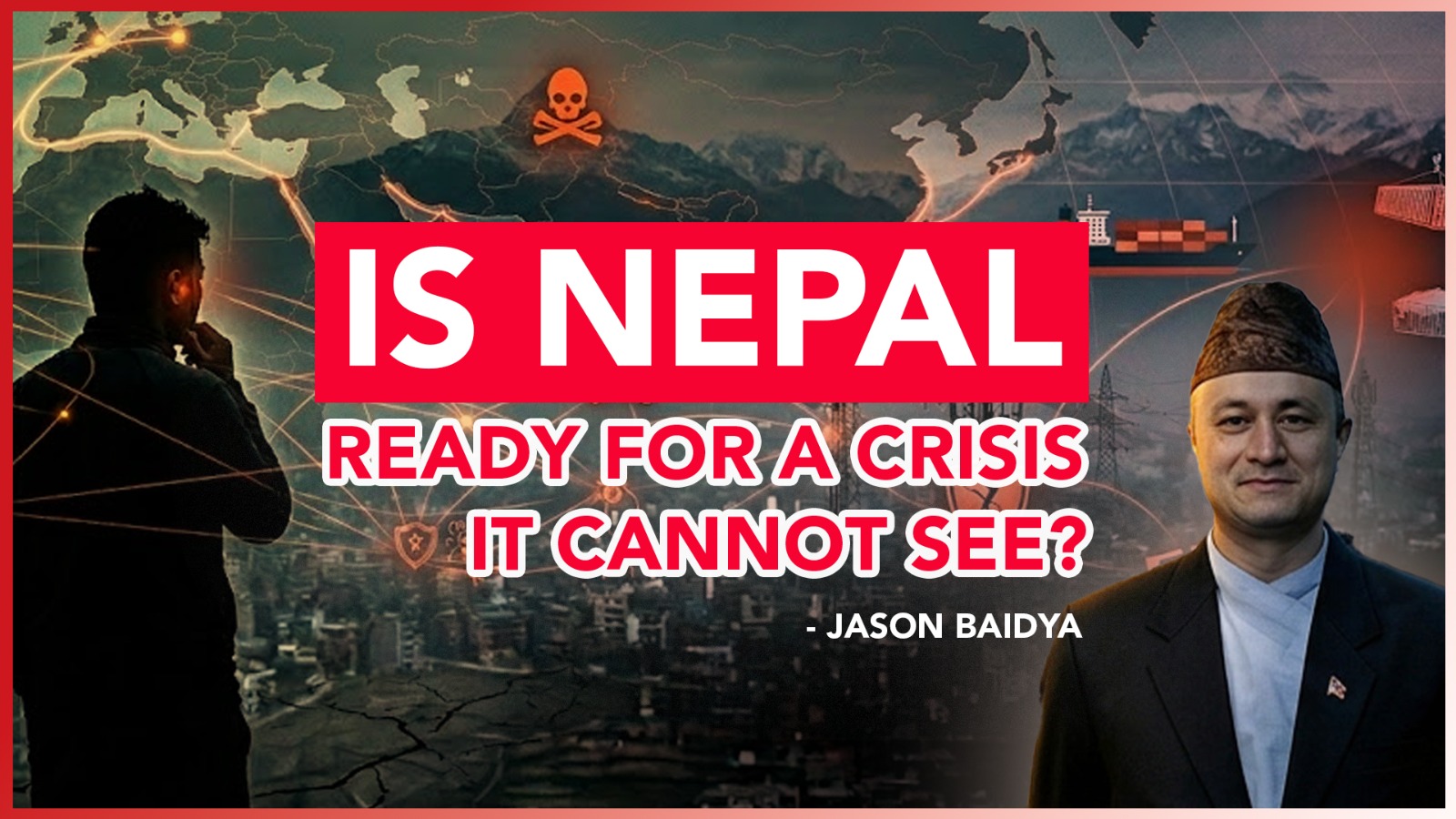
Nepal does not stand on the frontlines of war. No missiles cross its skies, no armies gather at its borders. And yet, in an interconnected world, distance no longer guarantees safety. The modern crisis does not always arrive with sound and spectacle—it travels quietly, through markets, supply chains, and systems that bind distant nations together.
What Nepal faces today is not a singular event, but the unfolding of a layered disruption—one that begins visibly and ends invisibly. The first phase is already here. It announces itself through rising fuel prices, through the daily recalibration of household budgets, through the silent anxiety of businesses adjusting to increasing costs. Nepal, entirely dependent on imported energy, absorbs global oil shocks almost instantly. Fuel becomes expensive, transport costs rise, and soon the price of everything follows. But this is only the surface. History reminds us that the world has stood at a similar crossroads before.
During the 1973–74 oil crisis, global oil prices rose nearly fourfold in a short span of time, sending shockwaves across economies. Inflation surged, growth slowed, and countries dependent on imports faced immediate vulnerability. But the deeper consequences were not limited to energy. As documented in global development studies of that era, the oil shock triggered a fertilizer crisis, since energy is a key input in fertilizer production. Between 1973 and 1974, fertilizer prices in many markets doubled or even tripled, while supply shortages disrupted agricultural systems. What began as an energy crisis evolved into a food security challenge—particularly for developing and import-dependent nations.
The lesson was simple, yet profound:
A crisis does not remain where it begins.
Today, the world once again finds itself in a similar moment—but with even greater complexity. As highlighted in recent discussions surrounding the International Monetary Fund’s 2026 Spring Meetings, the global economy is being tested by renewed geopolitical tensions, with policymakers warning that shocks are now transmitted more rapidly through energy markets, trade networks, and financial systems simultaneously. The concern is no longer just the shock itself, but the interconnected channels through which it spreads—and the limited resilience many economies have to absorb it.
This is where the present begins to mirror the past—yet also diverge from it. Beneath the visible fuel crisis, a slower and more structural disruption is unfolding. Global supply chains—those intricate systems that sustain production and consumption—begin to weaken under prolonged uncertainty. Trade flows become inconsistent, production cycles are disrupted, and reliability gives way to fragility. Here, the crisis changes form. It is no longer just about price, but about presence—and increasingly, about access.
Crude oil reveals its deeper significance in this phase. It is not only a source of energy—it is embedded within fertilizers, polymers, packaging, and industrial inputs. When its supply is disrupted, the consequences ripple outward. Agriculture faces rising input costs. Manufacturing slows. Entire value chains become unstable. The same pattern extends into healthcare. Nepal’s pharmaceutical sector relies heavily on imported raw materials and finished medicines, all of which depend on global logistics and production networks. When these systems are strained, shortages can emerge. Yet even when medicines remain available, rising costs can make them inaccessible for many. What unfolds is not merely a supply issue—but a dual crisis of availability and affordability. Within Nepal, these pressures interact with a fragile economic ecosystem—one sustained by remittances, consumption, and import dependence. Each element relies on the continuity of global systems.
When that continuity weakens, the ecosystem does not collapse immediately. It begins to erode. Rising prices reduce purchasing power. Reduced purchasing power slows demand. Businesses operate under pressure. Investment becomes cautious. Supply disruptions make goods more expensive and less reliable. Over time, the economy tightens—not through a single rupture, but through a gradual constriction of its own lifelines.
This is how economic systems decline—not abruptly, but through accumulation. And as the economic fabric stretches, the social fabric follows. Farmers face rising fertilizer costs—echoing the patterns of the 1970s crisis—while uncertain supply threatens productivity. Small businesses struggle to sustain operations. Employment opportunities shrink quietly. For households, the crisis becomes a continuous balancing act between necessity and affordability. Even healthcare becomes uncertain—not only because medicines may be scarce, but because they may no longer be within financial reach. Inequality widens. Stability becomes fragile.
On the grand chessboard of geopolitics, Nepal is not a dominant player. It does not initiate moves, nor does it shape global outcomes. Yet it occupies a position where the consequences of those moves are felt. Situated between major powers and deeply integrated into global systems, Nepal absorbs shocks it does not create. Neutrality does not guarantee insulation.
Nepal is not facing one crisis—it is facing a convergence. The immediate shock of rising fuel prices overlaps with the slower, more structural disruption of supply chains. Together, they create a dual pressure—weakening both demand and supply, both confidence and capacity.
The IMF’s recent observations reinforce this reality: today’s global shocks are more persistent, interconnected, and difficult to unwind. Recovery is no longer a simple return to normal—it is a prolonged adjustment to a new and uncertain equilibrium. And this is where the deeper philosophical question emerges. The true nature of a crisis is not defined by how it begins, but by how it lingers. Fuel prices may stabilize. Supply chains may adapt. But the structural strain—the weakened systems, the reduced resilience, the accumulated pressure—remains long after the initial shock fades.
History has shown this before. But today, the scale is broader, the connections tighter, and the consequences more enduring. Nepal stands, not at the center of conflict, but within its consequences—on the edge of a global system that is itself under strain. And so the question is no longer whether Nepal can endure a crisis. It has endured many. The real question is whether it is prepared for a different kind of crisis—one that does not arrive all at once, but unfolds gradually, spreads across systems, and reshapes the economy from within.