
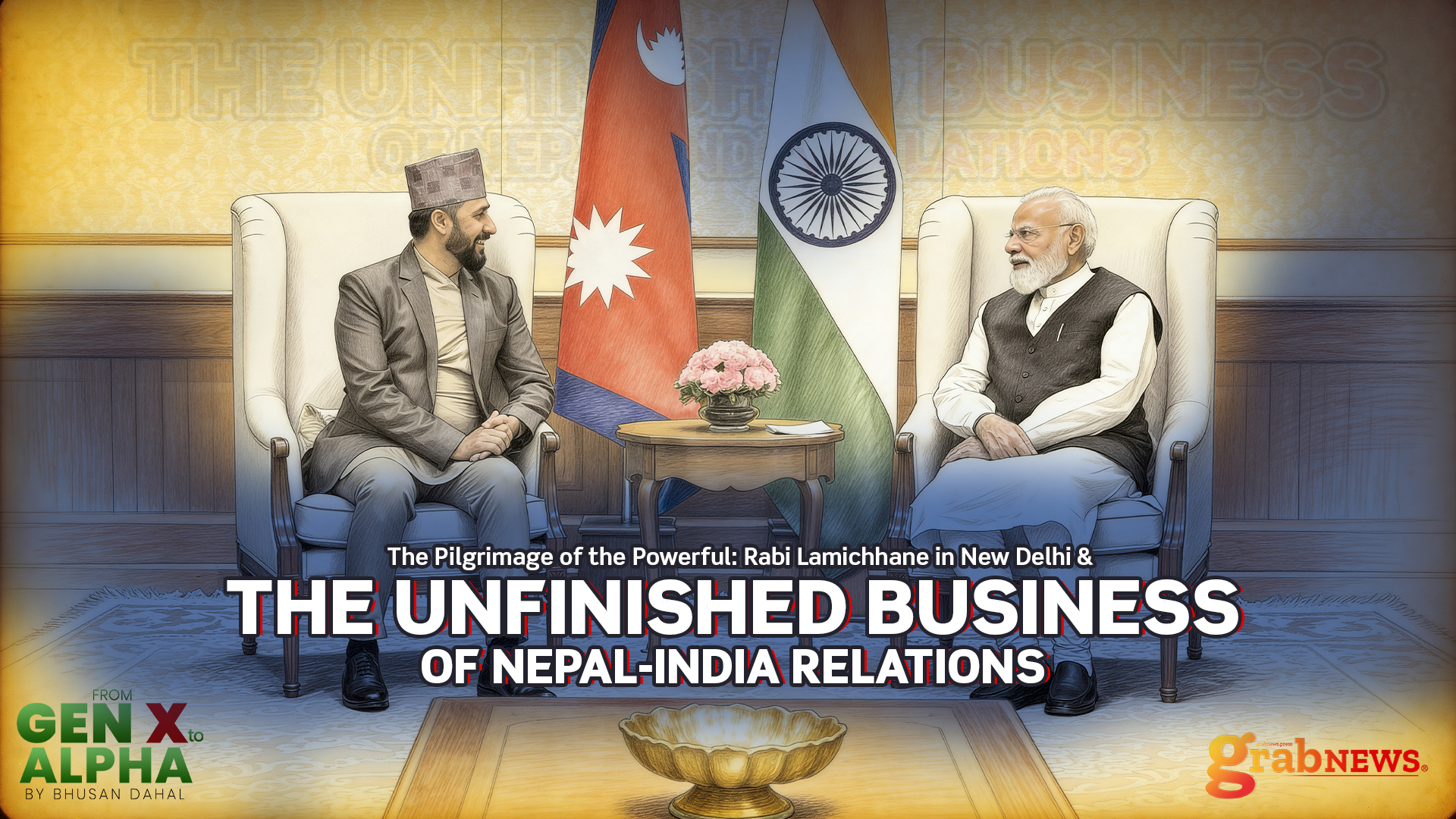
A Critical Analysis by Bhusan Dahal,| June 2026
Welcome to the Grand Durbar
When Rastriya Swatantra Party (RSP) chairman Rabi Lamichhane touched down in New Delhi on June 1, 2026, the Indian establishment rolled out the kind of reception that watchers of South Asian diplomacy have learned to decode like weather signs. Former ambassadors were quick to note that the warmth bestowed on him exceeded what had been extended to Sher Bahadur Deuba or even Pushpa Kamal Dahal “Prachanda” in their heyday. One seasoned Nepali observer reached for the highest comparison available: the reception Girija Prasad Koirala received from Manmohan Singh after the 2006 Loktantra Andolan when Singh reportedly greeted Koirala at Indira Gandhi International Airport himself, calling him “the greatest leader in South Asia.” It is worth pausing on that comparison, because it flatters everyone involved a little too easily. Koirala’s 2006 airport reception was, in no small part, a consequence of diplomatic protocol awkwardness rather than pure personal reverence. Nepal at that point had no functioning head of state in the conventional sense King Gyanendra had been stripped of his executive powers following the People’s Movement, but the republic had not yet been formally declared. Nepal was mid-transition, caught between a suspended monarchy and a not-yet-constituted republic. There was no settled Nepali head of state to whom India could extend the full Rashtrapati Bhavan ceremonial, no guard of honour at the presidential palace forecourt, no national anthem to play at the scheduled salute, no constitutional framework for receiving a Nepali prime minister who was simultaneously acting as de facto head of state in a political vacuum. The extraordinary airport reception, with Manmohan Singh departing from protocol to personally receive him on the tarmac, was in part a compensatory gesture a workaround by a host state that had itself engineered the constitutional void it was now navigating around with maximum theatre. And that brings us to the harder truth about the 2006 moment that the nostalgic comparison glosses over entirely. That transition which India’s foreign policy establishment celebrated as a democratic breakthrough was not an organic Nepali political settlement. The 12-Point Agreement, signed in New Delhi on November 22, 2005, between Nepal’s seven-party alliance and the CPN (Maoist), was brokered and hosted by India on Indian soil. New Delhi helped broker the understanding between the Maoists and Nepal’s political parties, enabling the rebels to emerge from the underground, and played a key role in convincing King Gyanendra to step down. In doing so, India openly took the lead role in transforming Nepal from a Hindu kingdom into a secular republic and in scripting the ouster of the monarchy entirely.
The republic that India midwifed into existence was supposed to produce a stable, India-friendly, secular democratic partner on its northern border. What it actually produced was eighteen governments in eighteen years, a rotating cast of coalitions that leveraged India’s patronage for domestic survival while resenting it publicly, an unimplemented Mahakali Treaty, a Kalapani map crisis, a 2015 unofficial blockade, and eventually in a final, spectacular repudiation the electoral annihilation of every party that had been a signatory to that 2005 New Delhi agreement, and the rise of an entirely new political force built by people who had watched the republic years with barely concealed disgust. The 12-point agreement crashed Nepal out of the stable constitutional polity it had carefully crafted over more than two centuries of Shah dynasty statecraft, replaced it with a fractured republic that India could not actually manage, and left Nepal’s sovereignty more vulnerable than it had been under the very monarchy it had displaced. The airport fanfare for Koirala in 2006 was, viewed from this angle, India enthusiastically congratulating itself for an intervention whose consequences it would spend the next two decades regretting and whose bill, in lost sovereignty and chronic instability, was paid entirely by Nepal. The five-day visit announced through a press statement that carefully listed BJP President Nitin Nabin as the inviting host rather than the Government of India proper packed in meetings with External Affairs Minister S. Jaishankar, Home Minister Amit Shah, senior BJP leadership at party headquarters, and, as confirmed on June 3, a coveted sit-down with Prime Minister Narendra Modi himself. In the shorthand of subcontinental diplomacy, getting Modi time is the gold standard. Lamichhane got it. The visit came with its own literary flourish. Writing in the Hindustan Times a platform choice that is itself a diplomatic signal of the highest order Lamichhane published an opinion piece titled “How Can an Aspiring Nepal and a Rising India Reconnect?” In it, he called for a fundamental reorientation of Nepal-India relations away from what he described as tired geopolitical suspicion and toward what he termed “development diplomacy.” He proposed the Raxaul-Kathmandu railway as a transformative connector, described Nepal’s hydropower potential as a gift to India’s energy future, and invoked Modi’s own 2014 vision of turning the border from a barrier into a bridge. He also said border disputes should not be weaponised for electoral nationalism but resolved through “historical facts, evidence, and mutual understanding.” The Hindustan Times piece was praised by Pankaj Sharma, a member of India’s National Security Advisory Board, who urged Indians and Nepalis alike to read it. Indian strategic studies professor S.D. Muni noted approvingly that Lamichhane “spoke about Nepal’s expectations, not India’s.” All of this is commendable in tone. But tone is the easiest thing to manufacture in South Asian diplomacy. The harder questions are the ones neither side raised in the press conferences, the ones buried in treaty clauses and GPS coordinates and the silent acres of land between border pillars.
- A Ghost at the Banquet: The 25th Anniversary No One Mentioned :
Here is a coincidence that the diplomatic choreographers of this visit either overlooked or chose not to acknowledge: Rabi Lamichhane arrived in New Delhi on June 1, 2026 the exact twenty-fifth anniversary of the Narayanhiti Palace massacre. On the night of June 1, 2001, Crown Prince Dipendra dressed in military fatigues, reportedly in a state of intoxication opened fire on his own family at a dinner gathering inside the royal palace, killing nine members of the royal family including King Birendra Bir Bikram Shah, Queen Aishwarya, Prince Nirajan, and Princess Shruti, before turning a gun on himself. The wound he inflicted on Nepal’s national psyche has never fully closed. In June 2001, Rabi Lamichhane was a 25-year-old man. He had not yet returned from the United States, had not yet become the television journalist who would make his name on the programme Sidha Kura Janata Sanga on News24, had not yet founded a political party or contested an election. He was, at that moment, a young Nepali of his generation one among millions who watched the monarchy they had grown up under simply cease to exist in a single catastrophic night. Whatever private grief or disorientation that generation carried from that event has never been publicly excavated. But it formed them. The Narayanhiti massacre is still, twenty-five years on, “shrouded in mystery,” as one Nepali news portal put it when marking the anniversary. The official verdict blamed Crown Prince Dipendra. Many Nepalis, then and now, found the official account implausible, incomplete, or politically convenient. Conspiracy theories involving RAW, palace factions, and regional interests have never fully gone away. What is not contested is the consequence: the massacre removed from the throne a king Birendra who had spent his reign carefully managing Nepal’s sovereignty between its two giant neighbours. He had promoted the concept of Nepal as a “Zone of Peace,” maintained a balanced, non-aligned foreign policy, and resisted pressures from both India and China that successive republican governments would prove far less equipped to resist. He had managed to maintain Nepal’s independence despite encroaching influences. He had accepted democratic reforms voluntarily in 1990, earning the genuine affection of his people rather than merely their obedience.
The republic that replaced the monarchy in 2008 after Gyanendra’s miscalculated attempt at direct rule and the subsequent 12-point agreement between parties and Maoists, brokered with significant Indian facilitation inherited none of that sovereign credibility. What it inherited was a class of political parties that had spent decades in rotation, accumulating corruption and foreign dependencies in roughly equal measure. The 35-plus years of “political dirt” that foreign policy adviser Chandra Bhatta referenced in his description of Nepal’s recent “ballot-box revolution” is precisely the detritus of the post-monarchy republic era. A nationwide survey conducted by Himalmedia in 2024 found that nearly half of Nepalis favoured the reversal of the country’s secular status and the reinstatement of the Hindu state. Pro-monarchy demonstrations in 2023 brought tens of thousands onto the streets of Kathmandu. In March 2025, thousands welcomed former King Gyanendra Shah at Tribhuvan International Airport with a crowd large enough to cause traffic gridlock across the capital. Two people were killed in pro-monarchy protests that same year. These are not the actions of a fringe; they are the expressions of a silent majority whose nostalgia is less about the romance of royalty and more about a felt loss of sovereign coherence. The argument for monarchy in contemporary Nepal is not, for most of its quiet supporters, an argument against democracy. It is an argument that the republic, as actually practiced, has delivered not democracy but a rotating oligarchy of parties none of which treated Nepal’s foreign policy as anything more than a tool for domestic coalition-building, foreign funding, and personal patronage. King Birendra’s foreign policy had a recognisable North Star: Nepal first. The republic’s parties have had many North Stars, most of them located in New Delhi, Beijing, or Washington D.C., depending on the season. The pro-monarchy sentiment also carries a specific anxiety about sovereignty that the republic era has systematically validated. The 2015 blockade which India conducted without ever officially acknowledging it would have been politically impossible to impose on a Nepal with an independent, institutionally grounded monarchy. The king’s court maintained direct, personal, and non-partisan channels to foreign capitals that parties, by their nature, cannot replicate. Gyanendra’s 2024 visit to Bhutan, where he was received with near-head-of-state honours by King Jigme Khesar Namgyel Wangchuck, illustrated that the monarchy still carries international recognition that no Nepali prime minister who might be out of office in six months can command. None of this is to say that Gyanendra himself, or a restored constitutional monarchy, is a solution to Nepal’s problems. The former king’s record during his own tenure was chequered at best and autocratic at worst. But the longing his institution represents is real. It is a longing for a Nepal that was not perpetually up for diplomatic purchase a Nepal whose sovereignty was institutionally anchored rather than dependent on the political survival calculus of whichever coalition held power that week. Rabi Lamichhane arrived in New Delhi on the anniversary of the night that anchor was cut loose. Whether or not he thought about it as his plane descended over the city, a generation of Nepalis did.
- The Elephant in the Durbar: Balen Shah’s Inconvenient Parliament Moment :
The Lamichhane visit did not occur in a diplomatic vacuum. Just days before his arrival, Prime Minister Balendra “Balen” Shah the 36-year-old former rapper and structural engineer who swept into power leading the RSP’s landslide in March 2026’s elections set off a parliamentary earthquake from which his own government is still scrambling to recover. Addressing Nepal’s Parliament for the first time on the contentious question of Lipulekh, Limpiyadhura, and Kalapani, Shah made the startling claim that Nepal had also encroached on Indian territory. The statement detonated across Kathmandu like a dropped temple bell. Former ambassadors Nilambara Acharya and Deep Kumar Upadhyay publicly called the statement not just wrong but diplomatically irresponsible, noting that no official records or studies have ever documented Nepal as having encroached upon Indian territory. India itself has never officially lodged such a complaint. Opposition parties demanded a retraction or proof. Nepal’s parliament descended into rare chaos. The Foreign Ministry issued a damage-control clarification suggesting Shah was merely referring to informal cross-border occupation within the no man’s land the so-called dus gaja strip a narrow buffer zone of ten yards along the open border where seasonal encroachment by farmers is a known and chronic issue, entirely different in legal and moral character from the state-level territorial disputes in the northwest. The clarification satisfied almost no one. What Shah’s gaffe actually illuminated however clumsily was the chronic Nepali habit of politically neutering its own territorial claims. For a sitting prime minister to volunteer an admission of encroachment that India has never even raised, on the eve of his party chairman’s visit to New Delhi, struck foreign policy veterans as either strikingly naïve or, more unsettlingly, pre-emptively conciliatory. The timing, right before Lamichhane’s trip, was not lost on anyone paying attention.
- The Map, the River, and the Treaty That Refuses to Work :
To understand why territorial questions produce such volcanic reactions in Nepal, one must understand what is at stake and what has been repeatedly conceded away. The dispute over Kalapani, Lipulekh, and Limpiyadhura approximately 400 square kilometres in Nepal’s far northwest traces its legal origins to the 1816 Treaty of Sugauli, which ended the Anglo-Nepalese War and designated the Kali (Mahakali) River as Nepal’s western boundary. The central argument is definitional: where does the river originate? Nepal insists the source is Limpiyadhura, which places Kalapani and Lipulekh unambiguously on the Nepali side. India has historically drawn the origin at a point that conveniently leaves a strategically vital high-altitude corridor bordering both China and Nepal under Indian administration. India has stationed paramilitary forces at Kalapani since the 1962 Sino-Indian War, a presence that was emergency in nature but has since calcified into permanence. A 1981 joint technical boundary committee delineated 98 per cent of the nearly 1,850-kilometre border, but Kalapani and the Susta region (some 140 square kilometres on the Bihar border, where the Gandak River’s shifting course has swallowed Nepali land) were explicitly left unresolved. The map was submitted for ratification in 2007. It never happened. The issue gathered decades of diplomatic dust. Then came the Mahakali Treaty of 1996 the “first bilateral water treaty” between Nepal and India, covering integrated development of the Mahakali River including the Sarada Barrage, Tanakpur Barrage, and the proposed Pancheshwar Multipurpose Project. Nepal ratified it by a two-thirds parliamentary majority. Critics in Nepal have since argued it was a Trojan horse: by formally recognising the Mahakali as a boundary river, the treaty locked in an implicit acceptance of the Indian-preferred origin of the river a cartographic sleight-of-hand that arguably made Nepal’s Kalapani claim harder to press. More damningly, the Pancheshwar project remains unbuilt. More than two decades on, the treaty’s core development promises have not been implemented. Nepal agreed to water-sharing arrangements, accepted boundary implications, and received little of the promised return.
Then, in 2020, Nepal amended its constitution and published a new political map incorporating Kalapani, Lipulekh, and Limpiyadhura as Nepali territory. India called it a “unilateral act” and warned against “artificial enlargement of territorial claims.” The language would have been unremarkable from any party to a border dispute except that Nepal’s map was based on the 1816 Sugauli Treaty itself. If the 1816 treaty is the agreed baseline, Nepal was not enlarging its claims; it was restating them. Lamichhane’s Hindustan Times article wisely declined to disappear these disputes. He called for their resolution through historical evidence and dialogue a position that sounds reasonable but historically the slower the resolution the more calcified India’s actual physical presence becomes. Development diplomacy is a worthy vision. But infrastructure projects built over disputed territory have a way of becoming their own facts on the ground.
- The Rooftop Temple and the Hindutva Litmus Test :
Every senior Nepali political leader visiting India has, in recent years, undergone a particular ritual that has very little to do with statecraft and everything to do with signalling. They are taken or expected to go to significant Hindu pilgrimage sites. Modi, himself an orchestrator of this soft-power liturgy, visited Nepal five times as prime minister, an unprecedented frequency for an Indian leader, and at each visit paid obeisance at Pashupatinath, Janakpur, and Muktinath. In 2018, he launched the Janakpur-Ayodhya bus service as a “Ramayan Circuit” while pledging a billion rupees for Janakpur’s development. The religious diplomacy was calculated playing to Hindu nationalist sentiment at home while projecting cultural hegemony outward. The reverse dynamic is increasingly visible when Nepali leaders visit India: they are steered toward temples and dharmic spectacles that carry a distinctly Hindutva flavour the RSS-adjacent shrines, the Ayodhya Ram Mandir that Modi inaugurated in January 2024 and which has become a near-mandatory pilgrimage stop for regional politicians seeking BJP approval rituals whose political grammar is Hindutva rather than Hinduism in its broader, more syncretic sense. This matters because Hinduism as practiced in Nepal is fundamentally different in character from the politically-mobilised, upper-caste, north Indian Brahminical Hinduism that powers BJP’s electoral machine. Nepal’s faith traditions are famously accommodating woven through with Vajrayana Buddhist influences, Newar syncretic practices, Kirat indigenous spirituality, and a tolerance of local variation that makes the Pashupatinath temple’s Bhat priests (traditionally from South India’s Shaiva traditions) presiding over a shrine in a country where Hindus and Buddhists have coexisted for centuries. Shiva worship in the Kathmandu Valley is inseparable from Buddhist iconography. The hills and forests of Nepal contain Bon and animist practices older than any Sanskrit text.
When BJP figures and their allied Hindu organisations pressure Nepal to restore its Hindu Rastra status a campaign that Yogi Adityanath, UP’s chief minister, has championed with notable fervour they are importing a particular ideological product into a country whose own spiritual culture would find it alien and constricting. That several Nepali politicians even communist ones, like Prachanda visiting the Mahakaleshwar temple in Ujjain have been willing to perform Hindutva-adjacent rituals to score brownie points with New Delhi tells you more about the power asymmetry in the relationship than about any genuine shared theology. The implicit test when a Nepali leader visits India is: how Hindu are you, in the way we define Hindu? Lamichhane, leading what is fundamentally a modernist governance-reform party, must navigate this with care. A 36-year-old prime minister who campaigns on structural engineering and anti-corruption, and a party chairman who once led television journalism, cannot afford to be captured by a religious-ideological project that has little resonance with Nepal’s young, urban, digital electorate that brought them to power.
- India’s Revolving-Door Favourites: A Pattern of Preference :
One of the most consistent irritants in Nepal-India relations has been New Delhi’s transparent habit of favouritism calibrating warmth to Kathmandu based on the political identity and perceived obedience of whoever holds power at Singha Durbar. The pattern is well-documented and well-resented. When K.P. Sharma Oli released Nepal’s updated map in 2020 and moved to reset ties with China, Indian media and the Indian establishment made little effort to disguise their hostility. When Prachanda or Deuba were in power figures seen as more pliable or more familiar the relationship was publicly described as warm. India has been accused of operating back-channel relationships with specific party factions, using its economic leverage (Nepal’s landlocked dependence on Indian trade routes is near-total) to maintain influence, and deploying the Madhesi political question as an implicit pressure valve during constitutional disagreements. The 2015 unofficial blockade which New Delhi denied but which Nepal experienced as economic strangulation following the promulgation of its new secular constitution remains a defining wound in the Nepali public’s understanding of what Indian friendship actually means. The fact that the RSP’s arrival in power was greeted with an almost unseemly display of warmth Modi personally calling Lamichhane and Balen Shah on the phone after the election results, Jaishankar flying to the region, the Hindustan Times platform, the Modi meeting should be read with sober eyes. India is investing in Nepal’s new generation not out of pure affection but because the old parties the Congress, the communists have been politically exhausted and have left New Delhi’s influence networks in need of rewiring. A new party requires new cultivation. This is not a reason for RSP to spurn engagement. It is a reason to engage with clear-eyed nationalism rather than gratitude.
- The Cockroach in the Room: India’s Internal Turbulence :
Any serious analysis of Nepal-India relations in mid-2026 must account for the fact that India itself is in a moment of unusual internal political ferment. In May 2026, a satirical political movement called the Cockroach Janta Party erupted across Indian social media with the speed of a monsoon flood. Its trigger was an off-the-cuff remark by Supreme Court Chief Justice Surya Kant, who compared young, unemployed Indians who criticised institutions to “cockroaches and parasites.” The movement’s founder, Abhijeet Dipke a 30-year-old political communications strategist and Boston University graduate launched a parody party website on May 16. Within days, the Cockroach Janta Party had accumulated more than 22 million Instagram followers more than double the BJP’s 9.5 million on the same platform, and significantly ahead of the main opposition Congress party’s 13.9 million. The CJP’s manifesto proposed cancelling the licences of media houses owned by Mukesh Ambani and Gautam Adani two billionaires widely perceived as proximate to Modi’s establishment. Its four-point membership criteria unemployed, lazy, chronically online, professionally able to rant captured something the movement’s founders described as the genuine fury of a generation shut out of economic mobility in the world’s largest democracy. “The youth are really frustrated and the government is not acknowledging their concerns,” Dipke told the Associated Press. “The times are changing.” India is in its third consecutive BJP term. The machinery of dominance compliant media, institutional pressure, a Lok Sabha majority remains intact, but the social contract that once made that dominance feel inevitable is visibly fraying. Youth unemployment, press freedom concerns, and the monetisation of resentment through internet platforms have created an opposition that is structurally immune to the traditional tools of political suppression. You cannot arrest a meme. For Nepal, this matters. An India increasingly absorbed in internal political tension, managing a restive young population and a ruling party that just won West Bengal and Assam elections but faces new legitimacy questions, is an India whose foreign policy bandwidth toward its smaller neighbours may be more constrained than usual. It is also, potentially, an India more willing to offer Kathmandu symbolic warmth the five-star welcome, the Hindustan Times op-ed, the Modi meeting precisely because substantive concessions (on Kalapani, on the Mahakali treaty, on trade asymmetry) are domestically inconvenient.
- Nepal First: The Generation That Refuses the Old Terms :
What makes this moment genuinely interesting and genuinely different from previous cycles of Nepal-India warming and cooling is the character of the political force now in power in Kathmandu. The RSP and the broader cohort of young Nepali politicians it represents came to power not through the old machine politics of caste networks and party cadres but through digital mobilisation, anti-corruption sentiment, and a population exhausted by decades of rotating coalition governments that produced movement but no motion. Balen Shah is 36. He began as an independent mayor of Kathmandu, a rapper, and a structural engineer. He was arrested hours after taking the prime ministerial oath for investigation into deaths during the 2025 Gen Z protest crackdown” a move that signalled both the legal reform impulse and the turbulent terrain he operates in. The RSP’s March 2026 landslide the first single-party parliamentary majority in Nepal in decades was not delivered by ideology but by a demand for competence. This generation of voters is not anti-India. But it is not the supplicant Nepal that previous generations’ political elites sometimes modelled. Young Nepalis who have grown up on the internet, who lived through the 2015 earthquake and the blockade in the same year, who watched the Kalapani controversy unfold on YouTube, who sent remittances from India and Malaysia and Qatar home and still couldn’t get a decent road built in their district these voters have a clearer-eyed view of what the relationship with India has cost Nepal and what it could, done differently, deliver. Lamichhane’s Hindustan Times article, for all its diplomatic emollience, contained within it a quiet demand: Nepal’s expectations matter, not just India’s. His vision of “development diplomacy” is not naive it is a deliberate attempt to shift the relationship from a patron-client dynamic to a partnership of mutual interest. The Raxaul-Kathmandu railway, if built, would not serve India’s strategic interests alone; it would give Nepal its first rail link and fundamentally reshape its trade dependency. Hydropower sold to India at fair prices would generate Nepali revenue. These are not gifts. They are transactions between neighbors. The demand for a reset is real. The energy is authentic. But energy and authenticity have been visible at the start of previous Nepal-India thaws, too. The test will come not in the Hindustan Times but in the dusty meeting rooms where Mahakali treaty implementation schedules are negotiated, in the border commission proceedings where Kalapani and Susta are perpetually deferred, in the customs points where Nepali exports face non-tariff barriers, and in the quiet moments when New Delhi’s investment in RSP is expected to produce diplomatic returns.
- Conclusion: Reading the Welcome Correctly :
Rabi Lamichhane’s India visit is the most significant diplomatic contact between Kathmandu and New Delhi in years. The RSP’s electoral mandate is genuine. The desire for a new relationship is genuine. The Hindustan Times article was thoughtful, and India’s welcome was warm. But Nepal has been welcomed warmly before. The Mahakali Treaty was signed with warmth. The 2014 Modi visit to Kathmandu was electric with warmth. Warmth in South Asian diplomacy is not the same as equity. The honest accounting of the relationship requires Nepal’s new leadership to hold two things simultaneously: the pragmatic necessity of deep engagement with its giant neighbour to the south, and the firm knowledge that this neighbour has historically engaged on terms that benefit itself. Balen Shah’s parliament stumble on the dus gaja encroachment question was a reminder of how easily a new government can surrender leverage it hasn’t even catalogued yet. Lamichhane carries genuine credibility with India’s establishment, with Nepal’s public, and with the region’s diplomatic community. The question is whether he and his generation will use that credibility to finally press the unfinished business the Kalapani boundary, the Mahakali deadlock, the Susta silting or whether the warmth of New Delhi’s reception will make those questions feel impolite to raise. Nepal’s new generation deserves both the railway and the river.
About the Author, Bhusan Dahal is a veteran Nepali television personality, filmmaker, and media professional with over three decades in the industry. He hosts The Bravo Delta Show on grabNEWS, and has directed music videos for some of Nepal’s most celebrated artists. He is also known as the director of Kagbeni, his debut feature film. He writes regularly on social, cultural, and political issues that he believes the younger generation of Nepalis must understand, own, and carry forward.
Bhusan Ji,Namaste,
A brilliant write up and an eye opener for the audience at large.Astu.