

Let me begin with a confession. Not the kind that ruins careers, just the kind that quietly explains them.
Human beings are performers.
All of us.
Some are brilliant. Some are unbearable. Most of us are somewhere in between, rehearsing lines we never wrote for audiences we never chose. We perform for family, for friends, for bosses, for voters, for followers, and occasionally for people we do not even like. We perform at work, at dinner, at weddings, and sometimes while walking down the street, just in case someone is watching. The stage changes. The costume changes. The audience changes. The performance does not. And somewhere in the middle of all this effort, life leans in and asks a very inconvenient question: Are you living, or are you just very good at pretending? This is not a new problem. Humans have been confused about this for centuries.
Long before smartphones, before television, before anyone thought it necessary to photograph lunch, people were already struggling with the same issue. Philosophers noticed it. Prophets noticed it. Poets noticed it. Mystics noticed it. The only group that seems consistently surprised by it is us. Take the Bhagavad Gita. Arjuna arrives at a battlefield and suddenly freezes. Not because he forgot how to fight, but because he starts worrying about judgment, reputation, and consequences. Krishna steps in and says something radical. Do your duty. Stop worrying about applause. That is not just spiritual advice. That is psychological survival. Ask yourself: Am I doing this for myself or for approval? Living for approval stops you from living truthfully. Today, we call it personal branding.
Move north, toward the Himalayan foothills, and you meet the Buddha, a man who looked at human life and calmly concluded that suffering comes from attachment. Attachment to praise. To identity. To what others think. In the modern world, he might have added, attachment to notifications. The more you seek validation, the more fragile your peace becomes. This explains why people check their phones as if they were monitoring a heartbeat. He also reminded us that everything changes. Reputation shifts. Public opinion moves. What people praise today, they criticize tomorrow. Building your life on that is like building a house on moving water. Christianity arrives and says something equally uncomfortable. Be sincere. Do the right thing even when no one is watching. A beautiful idea, slightly complicated by the invention of cameras. Now someone is always watching, often with better lighting than reality itself. In Islam, intention becomes central. What matters is not just what you do, but why you do it. There is even a warning against performing good deeds for the sake of admiration. That idea would struggle in an age where even generosity comes with hashtags. Jain’s thought takes it further. Truthfulness is so strict that even exaggeration feels dishonest.
No performance, no decoration, just reality as it is. Sikhism adds clarity. Work honestly. Remember deeply. Do not turn life into a spectacle. At this point, multiple traditions across centuries are essentially delivering the same message: stop acting. And then we arrive at Nepal’s own traditions, including the Kirant worldview, in which life is not something to display but something to live through relationships, rituals, and responsibilities. And when you think the lesson is complete, the mountains decide to participate. In the indigenous Himalayan traditions, including Bon, nature is not scenery. It is present. Mountains do not care about your image. Rivers are not impressed by your reputation. You cannot perform authenticity in front of a mountain. The mountain will expose you immediately. In such a world, being real is not philosophy. It is basic survival.
Then comes Rumi, who looks at all of humanity and summarizes it perfectly. You spend half your life trying to please others, and the other half worrying about what they think. Efficient. Exhausting. Completely unnecessary. Now imagine all these voices walking through the modern world. Krishna sees endless scrolling and wonders when reflection was replaced by refresh.
The Buddha notices that attachment has become an industry. Jesus sees virtue with filters. The Prophet reminds everyone that intention cannot be measured in likes. Rumi watches quietly and says, ” Ah, the performance has become professional.
Because now we have technology. Not just tools, but very ambitious tools. Tools that observe you, measure you, suggest things to you, and occasionally understand your behavior better than you do. Social media does not just show life. It edits, filters, and packages it. People are no longer just eating. They are presenting food. They are not traveling. They are documenting existence. They are not expressing opinions. They are broadcasting them with performance metrics. Even anger now comes with timing and presentation. And the younger generation is expected to focus deeply while being constantly interrupted. It is like asking someone to meditate inside a fireworks display. Silence feels uncomfortable. Stillness feels unfamiliar. Thinking without sharing feels almost unnatural. Imagine sitting under the Bodhi tree, and your phone keeps buzzing. Enlightenment would need a very aggressive notification setting. Technology itself is not the problem. Every generation fears its tools. The printing press worried people. The radio worried people. Television worried people.
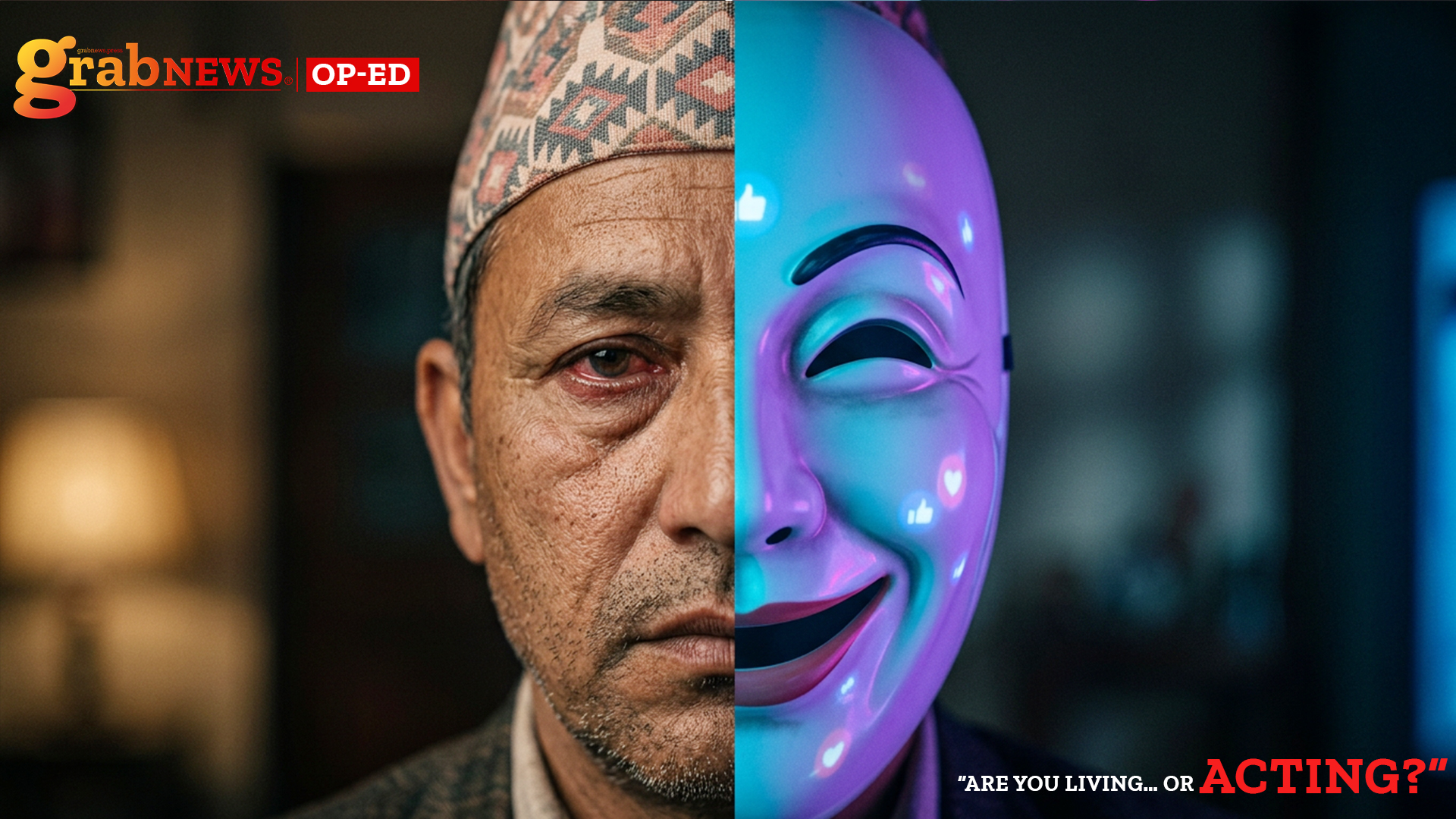
Technology is not the problem. The problem begins when the tool becomes the master. A smartphone can connect you to the world while disconnecting you from your own life, which is an impressive contradiction. And now we return to Nepal. Not just a country, but a place layered with philosophy. The Gita, the Buddha, indigenous traditions, and ethical teachings across religions all point in one direction. Be real. And yet, like everywhere else, modern Nepal is discovering performance. Politics becomes theater. Institutions become actors. Citizens become commentators. Social media becomes reality. Everyone is busy appearing alive. The irony is almost poetic. A civilization rich in the philosophy of authentic living is becoming highly skilled at pretending. But perhaps that is why this moment matters. It offers hope, showing that the path to authenticity is always available, waiting for you to choose it. Because the answer is already there. Across traditions, across centuries, the message is clear and reassuring: live honestly, act sincerely, and let go of the need for applause. It’s simple in principle, though challenging in practice. Simple advice. Extremely difficult to follow when notifications accompany applause.
This column, Janata-Janardan, begins with that question. Because people’s consciousness shapes a nation’s character. When individuals live authentically, institutions tend to become more authentic. When individuals perform constantly, public life becomes theatrical. The Nepali New Year, observed on April 14, is not just a change of date. It is an invitation to pause. So, on this occasion, a Happy New Year to all Nepalis, at home and across the world, and to anyone else currently trying to figure out whether they are living a life or managing a performance.
Perhaps this year, we can try something unusual. From Krishna, act without needing approval. From the Buddha, let go of the need for validation. From Jesus, be sincere. From the Prophet, check your intention. From Rumi, stop worrying about opinions. And maybe, just occasionally, look up from the screen. Walk somewhere without announcing it. Talk to someone without recording it. Think something without posting it. It sounds radical, but it is actually very old. Try living. Because the alternative is extremely popular. It is called pretending.

[Author Bio: Janardan Subedi is a commentator on society and civilizational thought. In “Janata-Janardan,” he explores contemporary issues through multi-disciplinary perspectives and the voice of the public.]