
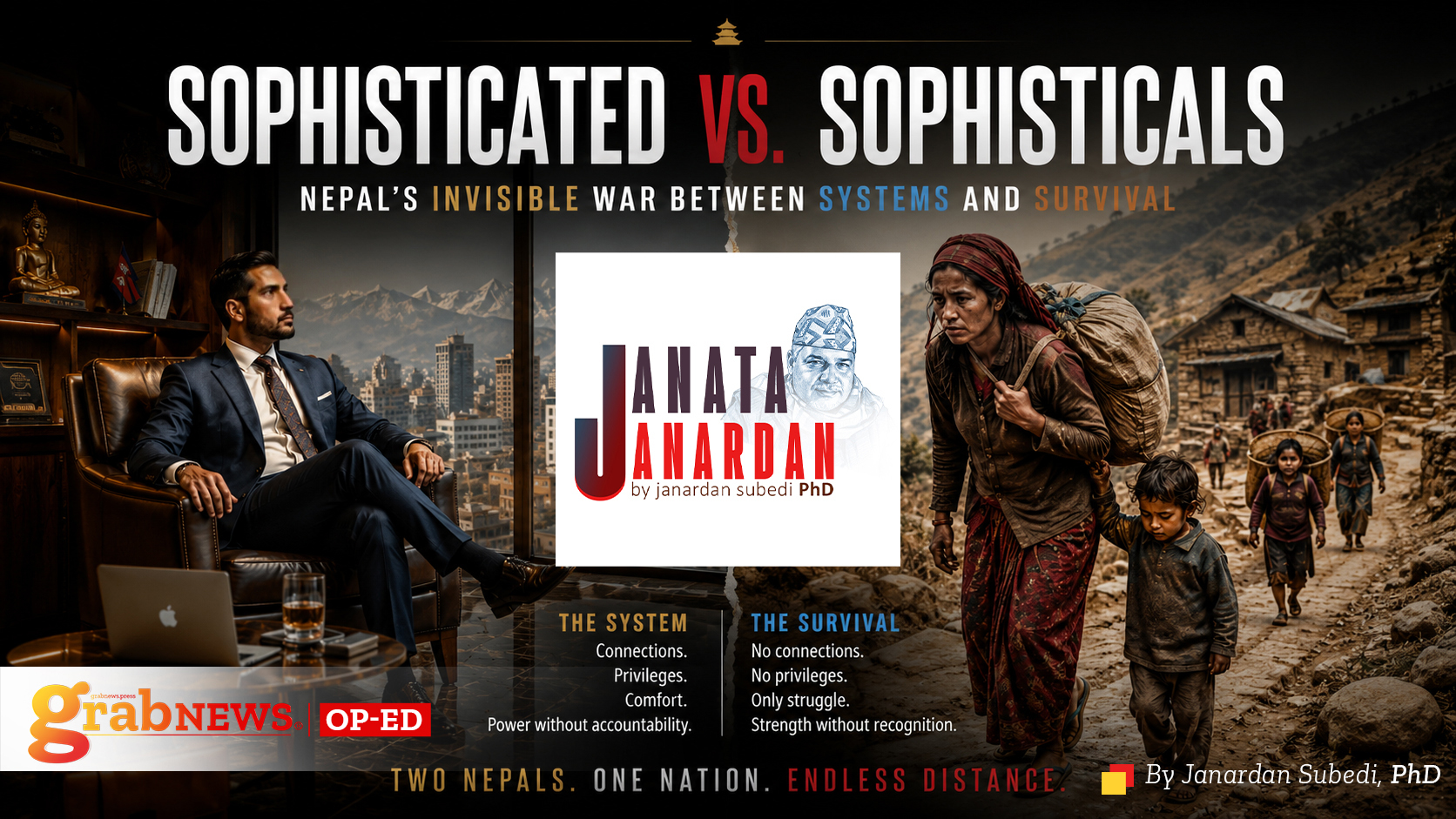

Recently, a friend of mine asked a deceptively simple question over tea. In Nepal, the most dangerous philosophical questions are never posed in universities, constitutional meetings, or policy seminars. They are asked between two sips of chiya, often with the calm confidence of someone who has already stopped believing the system will ever fully behave.
He smiled and said: “Nepali people are very bad in sophistication, but very good in sophisticals.” I laughed immediately.Then I stopped laughing. Because that sentence was not a joke, it was a diagnosis in disguise. Sophistication and sophisticals are not the same thing. One is the architecture of civilization. The other is the survival software that activates when the architecture fails. Sophistication builds systems so life does not require constant negotiation. Sophisticals emerge when systems fail, and society learns to survive through improvisation, relationships, emotional intelligence, and invisible bargaining.
Nepal has mastered the second more than the first one. And that is where the comedy begins. In Nepal, chaos is not merely a condition. It is a skill. A European engineer looks at a malfunctioning traffic system and says, “This must be fixed.” A Nepali driver looks at the same intersection and says, “There is a flow. You will feel it.” There is a flow. It is just not documented anywhere.Traffic lights do not always work. Lane discipline is mostly a suggestion. A motorcycle carries five people, a gas cylinder, and the quiet optimism that tomorrow will be more organized than today. A cow stands in the middle of the road like a retired bureaucrat who has seen too many policy reforms. And yet everything moves.
Not efficiently. Not safely. But continuously. That is sophistical. Sophistication aims to reduce societal uncertainty through formal systems, whereas a society that relies on sophisticals depends on relationships for stability. This is why, in Nepal, every process begins with one quiet yet decisive question:
“Who do you know?” Not: “What is the rule?” “What is your qualification?” “What does the law say?” But: “Who do you know?” Nepal does not run on bureaucracy. Nepal runs on relational electricity. A file rarely moves by procedure alone. It travels through invisible networks of cousins, classmates, district contacts, party links, and someone who once attended your uncle’s wedding in 2008 and still vaguely remembers your face in a useful way.
Western societies have digitized administration. Nepal has personalized it. We did not modernize the systems. We emotionalized them. Here lies the first paradox: in Nepal, uncertainty is not only a problem but also an economy. If every office suddenly worked efficiently, an entire informal profession of connectors, facilitators, and “helpful middlemen” would quietly disappear. In Nepal, dysfunction not only creates frustration but also creates a structure for survival.
Now consider time. In sophisticated systems, time is mathematical. In Nepal, time is social. A program scheduled for 11 AM begins when the room agrees it should. Not when the clock insists, but when the social hierarchy has fully assembled itself. A wedding invitation that says “Lunch at 1 PM” is not information. It is narrative fiction. Everyone knows lunch begins after speeches, delays, missing relatives, microphone failures, political commentary near the buffet line, and at least one uncle announcing the nation’s collapse with academic certainty. Nobody is surprised. Nobody is late. Everyone is correctly Nepali. Because the clocks here are not authoritative, they are decorations. Even infrastructure follows this logic. A road project announced for two years enters a state of temporal flexibility. Bridges become intergenerational assets. Construction sites become permanent features of the landscape. Sometimes it seems Nepal does not build infrastructure but instead creates future ruins, highlighting the complex relationship between progress and delay. It builds future ruins. And yet Nepal survives. This is the paradox. Despite the dysfunction, Nepal’s resilience should command respect, underscoring how societal survival fosters admiration and hope. Why? Because Nepalis have extraordinary social intelligence. Not institutional intelligence. Social intelligence.
We know how to ease conflict. We know how to survive scarcity. We know how to maintain relationships under pressure. We know how to laugh through a crisis. We know how to negotiate for dignity without breaking the connection. This is not sophistication. But it is civilization in a different form. A Nepali household with very little will still insist that guests eat first. A villager with minimal formal education may display generosity no policy framework can replicate. A tea seller may understand human psychology more precisely than consultants discussing “behavioral transformation strategies” in air-conditioned conference rooms. Nepal often lacks structure, but it does not lack intelligence. It lacks systems capable of harnessing that intelligence at scale. The danger lies in mistaking survival intelligence for genuine progress, prompting the audience to reflect on sustainable development.
Sophisticals are excellent for surviving dysfunction but dangerous when they become the default mode of governance. A society cannot modernize indefinitely by improvisation, access, emotional negotiation, and flexibility masquerading as morality. At some point, rules must operate without interpretation. Merit must matter more than proximity. Institutions must outlast personal relationships. But this is difficult because sophisticals are addictive. Once a society learns to bypass systems emotionally, it begins to fear the systems themselves. Rules feel threatening because they remove privilege. This is why every Nepali opposes corruption in principle and favors flexibility in practice. We condemn bribery until our own file is delayed.
Then corruption becomes “adjustment.” We criticize nepotism while, in the same breath, calling on relatives for help. This contradiction is not an individual failure. It is a matter of historical memory. Nowhere is this tension more evident than in contemporary politics. When I observe the current Parliament, the government led by Balendra Shah, and the reactions surrounding them, I sometimes wonder whether Nepal is witnessing normal political disagreement or something more profound. A civilizational conflict between sophistication and sophisticals. On the surface, it appears to be ideology. One side speaks the language of reform, systems, transparency, efficiency, legality, and discipline. The other speaks the language of realism, negotiation, inherited practice, procedural flexibility, and “understanding how Nepal actually works.”
But beneath the surface, a quieter argument is unfolding. One philosophy holds that society improves through systems. The other believes that society survives through relationships. One says, “If institutions become strong, society improves.” The other replies:
“If relationships break, society collapses.” Historically, Nepal has survived more through sophisticals than sophistication. That is why structural reform often elicits emotional resistance. Not because people reject change, but because change disrupts invisible survival networks built over time. In sophisticated systems, institutions replace negotiation. In Nepal, negotiation became institutionalized. That is why even minor administrative actions become politically charged. A footpath is more than a footpath. A street vendor is more than commerce. A parking rule is more than a regulation. A demolition is more than enforcement. Everything becomes emotional because disorder is not only disorder. It is livelihood, dignity, flexibility, and survival. Even reformers sometimes miss this. Efficiency alone does not confer legitimacy. A city is not a spreadsheet. A society is not an engineering diagram. Human beings are not traffic cones waiting to be optimized. Nepal operates through emotional ecosystems, inherited hierarchies, invisible obligations, and survival psychology passed down through generations. The old political class is fluent in sophisticals. It knows how to delay accountability, absorb outrage, create committees, and survive contradiction. The new reform forces arrive with sophisticated language. They speak in terms of systems, metrics, technology, law, and structure.
One side asks:
“Why is this not working?” The other side answers without saying it aloud:
“Because if it works, something else collapses.” That is the conversation beneath Nepali politics. Even Parliament increasingly feels less like an ideological struggle and more like a negotiation between two civilizational traditions. One side holds files. The other holds instincts. One trusts rules. The other trusts relationships. One seeks predictability. The other fears rigidity. And ordinary Nepalis stand in the middle, frustrated, amused, and still participating. The truth is uncomfortable: we want both. We want Swiss-level systems with Nepali-level flexibility.
We want strict law enforcement, except when it affects us. We want discipline without discomfort. We want order without inconvenience.
In other words, we want sophistication without losing sophisticals. That is Nepal’s central contradiction. And it is uniquely Nepali. This is not “South Asia.” It is Nepal. A country where mountains taught adaptation long before ideology arrived. A country where survival required negotiation before law was meaningful. A country where trust still travels faster through relationships than through institutions.
Even our humor reflects this truth. We laugh at authority while seeking favors from it. We criticize corruption while asking for “just one connection.” We condemn disorder while benefiting from it when convenient. This is not merely hypocrisy. It is a survival memory. The real question is not whether Nepal is sophisticated. The real question is whether Nepal can convert its sophisticals into systems without destroying its human warmth. Because sophisticals may help a nation survive through history. But only sophistication shapes its history. Perhaps Nepal’s real challenge is no longer survival. Whether survival intelligence can finally grow into civilization is the question.
[Author Bio: Janardan Subedi is a commentator on society and civilizational thought. In “Janata-Janardan,” he explores contemporary issues through multi-disciplinary perspectives and the voice of the public.]