Geography, Operational Depth, and Logistical Friction: The Strategic Inadvisability of a Land War in Iran

Abstract

Iran’s geography exemplifies the profound influence of terrain and environment on operational art. Spanning approximately 1.65 million km², the Iranian plateau features the Zagros Mountains (~1,500 km) in the west, Alborz Mountains (~1,100 km) in the north, and two of the harshest deserts in the world: Dasht-e Kavir (~77,600 km²) and Dasht-e Lut (~51,800 km²). These geographic features provide exceptional operational and geographic depth, shaping how campaigns are conceived, conducted, and sustained. Mountains constrain mobility and concentrate forces into narrow corridors, while deserts impose extreme environmental friction through heat, sand, and water scarcity. Together, these features compel attackers to plan for extended campaign timelines, dispersed troop formations, and complex logistical requirements, rendering any large-scale land war in Iran exceedingly costly in terms of time, resources, and personnel. This paper examines the strategic effects of Iran’s mountains and deserts, historical operational failures in comparable environments, the limitations of modern technology, and draws inferences on why geography alone provides a persistent defensive advantage.

Introduction: Geography as the Ultimate Constraint

In military theory, friction—a concept highlighted by Clausewitz—refers to the aggregate of all factors that reduce operational efficiency: distance, terrain, weather, and logistical complexity. Iran’s geography amplifies friction to extremes. The plateau’s mountains, deserts, and expansive territory systematically constrain movement, force dispersion of forces, complicate supply lines, and slow operational tempo. In practical terms, Iran is not merely a large state—it is a natural fortress where terrain shapes operational art as much as strategy or doctrine.

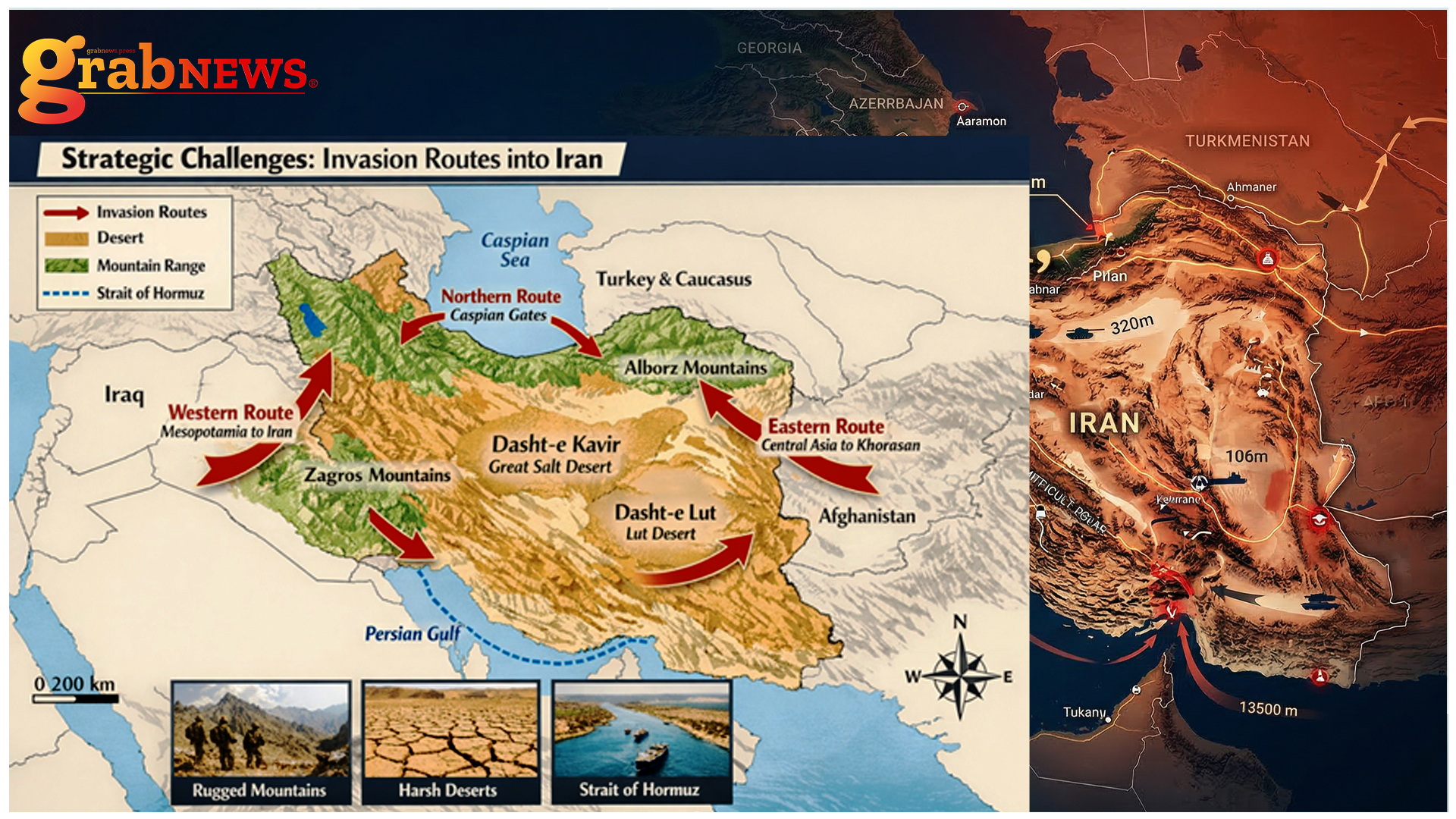
Figure 1 (see below) visually illustrates the interrelation of Iran’s mountains, deserts, and historical invasion corridors, highlighting how terrain naturally directs invading forces into narrow avenues of approach.

Figure 1: Strategic Map of Iran

Key geographic features of Iran, including the Zagros Mountains, Alborz Mountains, Dasht-e Kavir, and Dasht-e Lut, alongside the Western (Zagros), Northern (Caspian Gates), and Eastern (Khorasan) invasion corridors. These features illustrate natural chokepoints and operational depth that constrain military campaigns.

Operational Depth: Time, Terrain, and Troop Sustainment

Operational depth refers to the extension of military operations across time, space, and sustainment requirements. Iran’s mountains and deserts magnify these factors:

Mountains: Constraining Mobility and Consuming Forces

The Zagros and Alborz mountains dominate the western and northern approaches. Their steep slopes, deep valleys, and limited passes reduce mechanized mobility and force attackers into predictable avenues of approach. Historical campaigns repeatedly show mountains “eat troops” by slowing movement, complicating coordination, and generating attrition. Narrow passes concentrate forces, creating natural chokepoints where defenders can inflict disproportionate losses. Logistics are heavily burdened: transporting armored vehicles, artillery, and fuel becomes extremely challenging. Historical analogies—from Alpine operations (WWI) to the Soviet-Afghan War—illustrate how mountainous terrain systematically favors defenders.

Deserts: Environmental Friction and Logistical Nightmares

Iran’s deserts—Dasht-e Kavir and Dasht-e Lut—introduce additional environmental friction:

  • Extreme heat (up to 70°C in Lut) threatens personnel and vehicles.
  • Salt crusts, dunes, and marshes complicate mechanized mobility.
  • Water scarcity and navigation challenges extend supply lines and vulnerability.

The North African Campaign (WWII) provides a historical precedent: extreme heat melted rations (e.g., butter), fatigued troops, and degraded equipment. Iran’s deserts produce similar challenges but on a vastly larger scale, amplifying logistical burdens and operational timelines.

Temporal and Sustainment Depth

Iran’s 1.65 million km² forces campaigns to consider extended timelines and dispersed operations. Mountain passes slow columns; deserts require additional time for resupply and vehicle maintenance. Logistics stretching hundreds of kilometers are vulnerable to attrition or sabotage. The combination of environmental, temporal, and spatial constraints creates operational depth favoring defense.

Historical Operational Lessons

Several historical campaigns highlight the challenges of mountain and desert warfare:

  • Afghanistan (1979–1989, 2001–2021): Mechanized forces constrained by rugged terrain, dispersed insurgents, and long supply lines.
  • North African Campaign (1940–1943): Desert heat, sandstorms, and extended supply lines imposed severe strain.
  • Alpine Front (WWI): Narrow passes and steep slopes slowed movement and amplified defensive advantages.

These examples underscore that terrain friction and attrition significantly favor defenders. Iran’s combination of mountains and deserts magnifies these historical lessons.

Limitations of Modern Technology

Even advanced systems face constraints:

  • Mountains: Troop dispersal, terrain masking, and line-of-sight obstruction reduce the effectiveness of drones and ISR.
  • Deserts: Vastness and sandstorms degrade sensor performance and reduce persistence.

Technology cannot fully overcome the logistical friction imposed by geography, confirming that operational art remains terrain-dependent.

Strategic Implications: Iran vs. Afghanistan

Comparing Iran with Afghanistan illustrates the operational challenge:

  • Scale: Iran is roughly 2.5 times larger.
  • Mountains: Longer, higher, and more extensive ranges.
  • Deserts: Over 120,000 km² of extreme arid terrain.
  • Operational Depth: Greater distances between strategic objectives magnify logistical strain.

While Afghanistan repeatedly frustrated invaders, Iran’s geography exponentially increases resource, time, and personnel requirements, producing higher operational friction.

Deserts and Mountains as Operational Anchors

Iran’s mountains and deserts function as anchors of operational design:

  • Mountains anchor defensive positions, concentrating attackers into narrow passes.
  • Deserts anchor logistics, stretching supply lines and increasing vulnerability.

These features act as natural multipliers for friction, increasing attrition, delay, and operational cost, which must be factored into campaign planning.

Strategic Friction and the Inadvisability of Land War

Friction dominates the operational calculus:

  1. Mobility Friction: Mountains and deserts slow movement, limit concentration.
  2. Logistical Friction: Extended supply lines are vulnerable and resource-intensive.
  3. Attritional Friction: Heat, sand, and elevation reduce combat effectiveness.
  4. Technological Friction: Terrain and vastness limit the effectiveness of drones and precision systems.

Collectively, friction makes conventional land operations prohibitively costly, favoring defenders and increasing the strategic risk of offensive operations.

Conclusion

Iran’s terrain—mountains, deserts, and vast interior—creates a natural defensive depth. Operational and geographic depth extends timelines, disperses forces, and magnifies logistical demands. Historical analogies from mountains and deserts, coupled with the limitations of modern technology, highlight the persistent advantage of defenders. Any land war in Iran would be time-consuming, resource-intensive, and extremely challenging, underscoring the enduring strategic maxim that geography is among the most effective defenders in warfare.

Selected References

Clausewitz, Carl von. On War.
Van Creveld, Martin. Supplying War: Logistics from Wallenstein to Patton.
Keegan, John. The Face of Battle.
Atkinson, Rick. An Army at Dawn: The War in North Africa.
Gray, Colin S. Modern Strategy.
Dupuy, Trevor. Understanding War: History and Theory of Combat.
Wikipedia contributors. Dasht-e Kavir and Lut Desert.
United States Army Field Manual. Mountain and Desert Warfare Operations.


“PUNDITS” Stop Underestimating Balen Shah: Nepal’s latest Leader Isn’t Just a Rapper-He’s Poised to Transform a Nation

In the ever-shifting landscape of global politics, international and regional pundits have a habit of dismissing unconventional figures as fleeting novelties. Balen Shah, the 35-year-old former rapper and former mayor of Kathmandu, has been slotted into that category far too often. Labeled as a mere entertainer dipping his toes into politics, Shah article is frequently underestimated by analysts from Delhi to Washington, who view his rise through the lens of Nepal’s chaotic history rather than its potential future. But as Nepal hurtles toward a seismic political shift in 2026, with Shah emerging as the front runner for prime minister on the Rastriya Swatantra Party (RSP) ticket, it’s time for these opinion makers to wake up. Shah isn’t just “taking the top job”-he’s engineering a revolution that could redefine South Asian governance. And he’s far from alone in history; he’s following in the footsteps of numerous former mayors who ascended to national leadership in both developed and developing countries. Shah’s journey from underground rap battles to the mayor’s office in Kathmandu -and now potentially to the prime minister’s residence in Baluwatar embodies Nepal’s newest attempt to dismantle its entrenched political establishment. For decades, the Himalayan nation has been dominated by a revolving door of traditional parties like the Nepali Congress, UML, and Maoists, led by figures who’ve clung to power since the 1990s democratic transition. These “old guards”-think Sher Bahadur Deuba, Pushpa Kamal Dahal (Prachanda), and the recently defeated KP Sharma Oli-have overseen cycles of instability, corruption scandals, and economic stagnation. Even newer entrants like Gagan Thapa, a promising reformist from the Nepali Congress who positioned himself as a fresh face, have become collateral damage in this wave. Thapa, despite his charisma and anti-corruption rhetoric, couldn’t escape the taint of his party’s legacy, losing ground as voters rallied behind Shah’s RSP in a landslide that shattered expectations.

This isn’t mere populism; it’s a youth-driven uprising amplified by social media and street protests, culminating in the 2025 Gen Z-led movement that toppled Oli’s government over issues like a social media ban and economic mismanagement. Shah, who first burst onto the scene as an independent mayor in 2022, joined RSP in early 2026 and channeled that energy into a national platform. His campaign, blending anti-corruption anthems from his rap days with pragmatic urban governance reforms, resonated with a demographic tired of dynastic politics. By directly challenging and defeating Oli in his home constituency of Jhapa-5 with four times the votes, Shah didn’t just win an election he symbolized the death knell for Nepal’s political dinosaurs. Pundits who dismiss this as a fluke ignore the broader context: Nepal is attempting a wholesale replacement of its elite, much like other nations where mayors have leveraged local success to national transformation. History is replete with examples of former mayors who were once underestimated but went on to lead their countries, proving that urban leadership is often the ultimate proving ground for executive prowess. In developed nations, these transitions highlight how managing complex metropolises builds the skills needed for national stewardship. Take France, where serving as mayor is practically a prerequisite for higher office. Jacques Chirac, mayor of Paris from 1977 to 1995, used his tenure to modernize the city before becoming president in 1995, steering France through economic reforms and EU integration. Similarly, Valéry Giscard d’Estaing, mayor of Chamalières, ascended to the presidency in 1974, implementing progressive policies like lowering the voting age. François Mitterrand, mayor of Château-Chinon, became president in 1981 and led for 14 years, nationalizing key industries. Nicolas Sarkozy (mayor of Neuilly-sur-Seine) and François Hollande (mayor of Tulle) followed suit, each parlaying local governance into Élysée Palace victories. Even current French politics echoes this: Many prime ministers, like Alain Juppé (mayor of Bordeaux) and Édouard Philippe (mayor of Le Havre), started as mayors before leading the government. Across the Channel in the United Kingdom, Boris Johnson exemplifies this path in a developed democracy. As mayor of London from 2008 to 2016, he oversaw the 2012 Olympics and championed infrastructure like the Crossrail project.

Dismissed by some as a bumbling showman, Johnson leveraged his mayoral popularity to become prime minister in 2019, navigating Brexit and the early COVID-19 response. In the United States, while no mayor has directly become president, figures like Grover Cleveland (mayor of Buffalo, New York, before becoming governor and then president in 1885) and Calvin Coolidge (mayor of Northampton, Massachusetts, before vice president and president in 1923) show how municipal experience can propel one to the White House. More recently, Pete Buttigieg, mayor of South Bend, Indiana, ran a strong 2020 presidential campaign and now serves as U.S. Secretary of Transportation.

In developing countries, where political systems are often more volatile, former mayors have frequently risen to address systemic challenges, much like Shah in Nepal. Indonesia’s Joko Widodo, or Jokowi, started as mayor of Solo (Surakarta) in 2005, where he tackled urban poverty and corruption. He then became governor of Jakarta in 2012 before winning the presidency in 2014, focusing on infrastructure megaprojects that transformed the archipelago nation. In Turkey, Recep Tayyip Erdogan served as mayor of Istanbul from 1994 to 1998, improving water supply and public transport amid economic turmoil. Once derided as an Islamist outsider, he became prime minister in 2003 and president in 2014, reshaping Turkey’s economy and foreign policy. Mexico’s Andrés Manuel López Obrador (AMLO), head of government (equivalent to mayor) of Mexico City from 2000 to 2005, used his tenure to expand social programs before becoming president in 2018, prioritizing anti-poverty initiatives. China’s Zhu Rongji, an electrical engineer turned politician, served as mayor of Shanghai from 1988 to 1991, where he pursued economic reforms and opened the city to foreign investment, including developing the Pudong district. Handpicked by Deng Xiaoping, he rose to vice premier in 1991 and became premier in 1998, overseeing China’s entry into the World Trade Organization, banking reforms, and rapid economic growth that solidified its global powerhouse status.

Further afield, Argentina’s Mauricio Macri, mayor of Buenos Aires from 2007 to 2015, modernized the city’s infrastructure and then won the presidency in 2015, implementing market-oriented reforms. In the Philippines, Joseph Estrada was mayor of San Juan before becoming vice president and then president in 1998, drawing on his film-star charisma-much like Shah’s rapper persona-to connect with the masses. Colombia’s Gustavo Petro, former mayor of Bogotá (2012-2015), where he focused on inequality and education, became president in 2022. Even in Africa, Madagascar’s Andry Rajoelina, mayor of Antananarivo, rose to the presidency in 2009 (and again in 2019) amid political upheaval.

These leaders weren’t anomalies; they were visionaries who turned local frustrations into national mandates. Shah fits this mold perfectly-his Kathmandu mayoralty addressed garbage crises, traffic woes, and heritage preservation, earning him a cult following among urban youth. Pundits who reduce him to “just a rapper” echo the skeptics who once mocked Jokowi as a furniture salesman or Erdogan as a soccer player. Nepal’s 2026 election isn’t a sideshow; it’s a bold experiment in replacing fossilized parties with agile, people-centric governance. The RSP’s projected landslide, with wins in over 100 direct seats and dominance in proportional representation, signals a rejection of the old order, including figures like Thapa who, despite their merits, couldn’t outpace the RSP wave.

To international observers and regional commentators: Treat Shah’s ascent with the gravity it deserves. Nepal’s youth aren’t just protesting-they’re governing. Underestimating Shah risks missing one of the most compelling political stories of the decade. As he steps into the prime minister’s role, expect reforms in anticorruption, economic diversification, and youth empowerment that could stabilize Nepal and inspire neighbors. The world has seen mayors become legends before; it’s time to recognize Balen Shah as the next in line.