
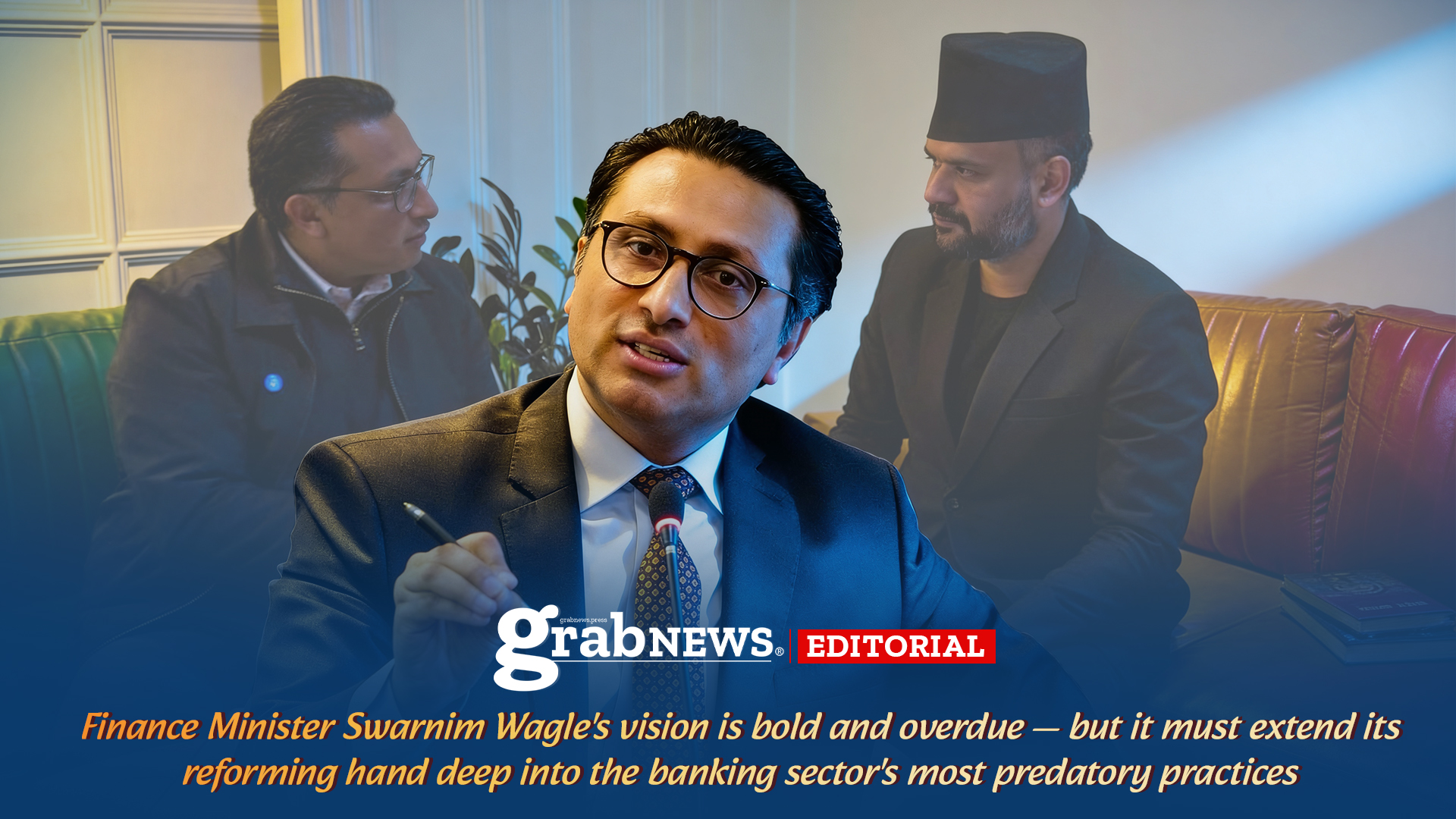
“Nepal stands today precisely where India stood in 2014 at $1,500 per capita income, at the threshold of a structural break. The question is not whether the opportunity exists. It is whether the political will to seize it, discipline the powerful, and protect the vulnerable is real and whether that will reaches all the way into the marble lobbies of our banks.”
Finance Minister Swarnim Wagle’s remarks at the Barakhari symposium represent perhaps the most candid and intellectually serious statement of economic intent heard from a Nepali finance minister in a generation. His willingness to name the disease the incestuous capture of policy by a coalition of corrupt politicians and opportunistic private actors and to pledge its surgical removal deserves not just applause but active, critical engagement. This editorial agrees with the broad architecture of his vision. But it argues that the reform agenda he has outlined remains incomplete in one critical dimension: the systematic and predatory behavior of Nepal’s banking and financial sector, which has for too long operated as a hidden tax on productive enterprise and a trap for honest borrowers.
The Crony Compact Must End Fully
Minister Wagle spoke with refreshing directness about the culture of elite institutional capture the back-room deals between businessmen and politicians that have disfigured Nepal’s policy landscape for three decades. He is right that this compact must be dismantled, that honest entrepreneurs have been forced into complicity by a system that rewarded proximity to power over productive investment. Scrapping fifteen antiquated laws on his first day in office was the right signal. But the crony compact has a financial arm that the minister has not yet addressed with the same force: the banking sector’s collateral-based monoculture, its loan-sharking tendencies, and its eagerness to foreclose, blacklist, and destroy rather than restructure, rehabilitate, and recover.
“The incestuous relationship between the business community and corrupt politicians has to end.” The same logic applies, with equal force, to the relationship between politically connected banks and the borrowers they have reduced to supplicants.”
For decades, Nepal’s banks have functioned less as engines of productive capital allocation and more as collateral warehouses. The dominant logic of Nepali banking is simple and deeply destructive: assess the value of fixed assets a borrower can pledge, lend against that pledge at high margins, and when the borrower stumbles as any entrepreneur in a volatile economy inevitably may move swiftly to foreclose, auction, blacklist, and walk away. The borrower is ruined. The bank books a loss anyway. The economy loses a business. And the system grinds on, unchanged.
Collateral-Based Lending: A Development Trap
There is a profound irony at the heart of Nepal’s banking model. The minister rightly points to digitalization and entrepreneurship as the engines of Nepal’s future growth. He envisions Nepali entrepreneurs sitting on mountaintops, connected to the world, building globally competitive enterprises. Yet the banking system that is supposed to fuel this transformation will only lend to those who already own land and buildings to pledge. A young software developer in Pokhara with a promising product, a women’s cooperative in Dang with a viable agricultural enterprise, a first-generation entrepreneur in Dhangadhi with no ancestral land these are precisely the people Nepal’s growth story depends upon, and they are precisely the people the current banking system excludes.
“Cash-flow lending, venture lending, and sector-specific credit guarantee schemes are not radical ideas they are the standard toolkit of every banking system that has successfully backed an economic takeoff.”
The minister’s own words echo this concern. He has spoken of “taul rahit, duri rahit” freedom from the burdens of weight and distance. We would add a third freedom that Nepal’s entrepreneurs desperately need: “dhito rahit” freedom from the tyranny of collateral. Cash-flow lending, intellectual property lending, group-guarantee lending, and robust credit guarantee schemes backed by the state are not radical ideas. They are the standard toolkit of every banking system that has successfully catalyzed an economic takeoff, from South Korea’s development banks of the 1970s to India’s MUDRA scheme of the present decade. Nepal’s banking sector has shown little appetite for any of them.
The Loan Shark in Institutional Clothing
The minister spoke with empathy about honest entrepreneurs being trapped in a system designed by corrupt predecessors, where even an honest person entering the system is twisted into dishonesty by its perverse incentives. The same analytical empathy must be applied to borrowers who have been caught in the financial sector’s most predatory practices. Interest rate spreads in Nepal’s banking sector have long been among the highest in the region, fattening bank balance sheets while strangling borrowers. Penalty interest structures compound with punishing speed. And when economic shocks arrive a pandemic, a remittance slowdown, an earthquake banks have shown a consistent preference for aggressive recovery over patient restructuring.
The Reform Agenda the Banking Sector Cannot Escape
- Mandatory loan restructuring protocols before any foreclosure proceedings can commence
- Independent Loan Restructuring Authority with binding powers over lenders and borrowers in distress situations
- Legal prohibition on blacklisting borrowers without a completed restructuring assessment
- Statutory caps on penalty interest accumulation during economic distress periods
- Credit guarantee schemes enabling cash-flow and enterprise-value based lending
- Mandatory disclosure of beneficial ownership in all bank borrowings above a threshold
- Ring-fencing of related-party lending within bank group structures
- Parliamentary oversight of NRB’s enforcement record not just its monetary policy stance
Restructure First, Foreclose Last
The minister has pledged that the forthcoming budget will protect private property and encourage contract enforcement. These are essential commitments. But the enforcement of contracts is only just if the contracts themselves were entered into on fair terms, and if when those contracts face stress, the stronger party the licensed bank is required to act in good faith rather than moving immediately to strip assets. Nepal needs a legal architecture that makes loan restructuring the mandatory first response to borrower distress, not an optional grace extended at the bank’s discretion after it has already initiated auction proceedings. The Nepal Rastra Bank’s existing restructuring guidelines are weak, inconsistently applied, and heavily tilted toward lender convenience. What is needed is a statutory Loan Restructuring Authority with the power to compel lenders to the table, assess the genuine viability of distressed enterprises, impose restructuring terms where appropriate, and only sanction foreclosure as a last resort after a transparent process. This is not soft on debtors. It is economically rational. A restructured loan that recovers eighty percent of principal over five years is better for the banking system, better for employment, and better for the economy than a forced auction that recovers fifty percent of collateral value while destroying a functioning business and its workers’ livelihoods.
The Blacklist as a Weapon of Exclusion
Perhaps no instrument in the Nepali financial system causes more disproportionate damage than the credit blacklist. A borrower who falls behind on a single installment often because a bank has failed to process a restructuring request in good faith can find themselves on the Credit Information Bureau’s blacklist, permanently excluded from the formal financial system, unable to access even a basic business account. The blacklist, designed as a tool of systemic risk management, has become a weapon of lender convenience and, in some documented cases, a tool of deliberate pressure against borrowers who challenge predatory terms. Reform here is not complicated. Blacklisting should require a completed restructuring assessment. It should trigger an automatic right of appeal to an independent adjudicator. It should be time-limited, not permanent. And any blacklisting found to have been imposed without due process should carry consequences for the lending institution, not just reputational damage to the borrower. The minister’s commitment to building a private-sector friendly economy rings hollow if honest entrepreneurs can be financially executed by a bank manager’s unilateral decision without recourse.
Banking Sector Governance: The Cronyism Within
The minister’s critique of policy capture applies with full force inside the banking sector itself. Nepal’s commercial banking landscape is riddled with related-party lending banks controlled by business houses extending credit to connected entities, often against the letter of NRB regulations and certainly against their spirit. Board composition in many banks reflects the same political-business nexus the minister has pledged to dismantle. The result is a sector where capital allocation mirrors political relationships more than economic merit, and where the NRB’s supervisory capacity often understaffed and politically influenced in its senior appointments has struggled to keep pace with the sophistication of regulatory arbitrage.
“A banking sector that serves the powerful and forecloses on the struggling is not a market it is a mechanism for compounding existing inequality at compound interest.”
True fiscal innovation, of the kind the minister envisions, requires a banking system that allocates capital on merit, that prices risk accurately, that lends to the future rather than the past. This cannot coexist with a governance structure where loan decisions are influenced by who sits on whose board, and where NRB enforcement is selectively applied. The minister’s budget must include specific commitments to banking sector governance reform: mandatory arm’s-length requirements for related-party transactions, cooling-off periods for politically exposed persons joining bank boards, and transparent, merit-based processes for NRB’s senior appointments.
The Path Forward: Agreeing Where It Matters Most
Let us be clear about what this editorial endorses without reservation. The minister is right that Nepal’s structural moment has arrived. He is right that reforms must be bold, government predictable, and execution relentless. He is right that the culture of elite capture must end, that honest entrepreneurs deserve protection, and that digitalization is Nepal’s most powerful lever against the tyranny of geography. He is right that Nepal at thirty million people, at $1,500 per capita, with two of the world’s fastest-growing economies as neighbors, has an extraordinary opportunity that previous governments squandered through venality and timidity. He is right that the manifesto must be honored, that stability and policy predictability are themselves powerful economic inputs, and that the private sector’s creative energy unleashed on a level playing field is the engine, not the government. But an engine requires fuel, and the fuel of a modern entrepreneurial economy is fairly priced, equitably accessible capital. Nepal’s banking sector, left to its current incentive structure, will ration that fuel to the connected and deny it to the deserving. Fiscal innovation without banking reform is a house built on one side only. The minister’s admirable vision of a Nepal where honest entrepreneurs thrive, where governance is clean, and where the economy grows at seven to ten percent annually requires, as its foundation, a financial sector that is itself governed with integrity, that lends on merit, that restructures before it forecloses, and that treats a defaulting small business owner with the same seriousness of process as it would demand for itself. Nepal’s Gen Z movement, which brought this government to power ahead of schedule, was in part a revolt against a system where opportunity was rationed by connection. Let the banking reform that this moment demands be the government’s answer to that revolt proof that the structural break the minister speaks of is not merely rhetorical, but reaches all the way to the credit windows where Nepal’s next generation of entrepreneurs will either be empowered or turned away. The ship, as Minister Wagle eloquently put it, needs only a narrow nudge to arrive at a completely different destination. We are agreed on the destination. We urge that the nudge extend to the banks as well.
- This editorial is based on the remarks of Finance Minister Swarnim Wagle at the Barakhari Leadership Symposium, Gokarna, 2026.